Frankfurt guide
Ostend, Frankfurt: the Harbour Quarter Learning to Breathe
East of Frankfurt’s centre, Ostend folds the ECB, the river, the zoo and a working harbour into a district that feels mid-sentence rather than finished.
 By Elena Vogt

Ostend begins with a contradiction you can see from the riverbank: a 185-metre European Central Bank tower twisting up from a 1920s market hall, as if Frankfurt had decided to place its future on top of its past and leave the seam visible. The district is east of the centre, stretched along the Main and the Hanauer Landstrasse, and it still carries the old harbour-and-warehouse logic in its bones. But the mood has shifted. Coffee roasters have moved into the long, functional avenue once ruled by car showrooms. Wine bars have found their way into former service buildings. A boiler house now throws parties under tiki lights. Ostend does not polish itself for company, and that is exactly why it feels alive.
What Ostend is known for
The district’s defining image is the ECB complex, and the reason it works as a symbol is that it refuses to separate glamour from burden. The headquarters, built by Coop Himmelb(l)au and opened in 2014-15, rises out of the Grossmarkthalle, Frankfurt’s former wholesale market hall from the 1920s. The old hall was once nicknamed the "Gemieskirch", the vegetable church, which sounds almost affectionate until you remember what happened in its cellar and on the rail sidings outside. From 1941, the Gestapo used this place as the assembly point for the mass deportation of Frankfurt’s Jews; ten transports between October 1941 and September 1942 sent some 10,050 people east. The memorial at the Grossmarkthalle keeps the surviving fragments in view — cellar, ramp, signal box, footbridge, tracks — and the publicly accessible section along the Philipp-Holzmann-Weg is one of the most important walks in the district.

That is Ostend in one frame: finance, architecture, memory. But the district is not only its most famous building. It grew up around the Osthafen, the east harbour cut in 1912, and around Hanauer Landstrasse, a wide avenue that still feels built for trucks, not flaneurs. Even now it is Germany’s highest-turnover car-dealer street, which gives it a strange double life. You pass showrooms and service yards, then a roaster, then a design hotel, then a wine bar with a communal table. The street does not tidy itself into a narrative. It just keeps going.
That is the appeal. Ostend is not trying to be a postcard district. It is a place where central-bank staff, lawyers, long-time working-class families, students and creative workers all occupy the same broad geography without pretending to be the same crowd. By day, the glass blocks around the ECB feel sleek and moneyed. By evening, the docks get rougher and more industrial. Up around Wittelsbacherallee and Ostpark, the streets settle down into something leafy and residential. The district is still mid-transformation, and you can feel the change block by block.
Where to eat & drink
If Ostend has a culinary spine, it is Hanauer Landstrasse, and the best way to read it is by starting with a sausage. Gref-Völsings, founded in 1894, is the old Frankfurt answer to the question of what belongs here. It invented the beef-only Rindswurst for the city’s Jewish customers, and it still serves it over the counter on the Hanauer Landstrasse. Order one with mustard and a roll, eat it standing up, and you will have understood something essential about the district: it values continuity, but it does not dress it up.

From there, the coffee route tells the newer story. Aniis at Hanauer Landstrasse 82 is the flagship third-wave cafe of the east, with proper filter and espresso, homemade cakes, and a mostly vegetarian brunch and lunch. It is the sort of room that helped signal Ostend’s shift long before anyone started calling the district trendy. The mood is calm, precise, and a little self-aware, as if the place knows it is working inside a neighbourhood still learning how to be desirable without becoming decorative.
A few streets on, Hiroshi at Hanauer Landstr. 125 keeps the food conversation clean and unshowy. It does sushi and ramen, but also Vietnamese bowls, and the weekday lunch is good value. The space is pared-back and avoids the usual noisy Asian-restaurant clichés. That matters here. Ostend rewards places that know how to be direct.
Drinking, too, has found its own pace. East Grape, tucked into the Louis-Appia-Passage, is the most serious of the wine bars: more than 150 bottles, strong on Riesling and rediscovered grapes, and a big communal oak table that makes the room feel like a conversation rather than a performance. The Hessian snacks — especially Spundekäs with pretzels — keep it rooted in place. Marmion on Lindleystrasse is smaller and quieter, pouring German, French, Austrian and Italian wines without much fuss. For something more playful, Trinkhalle on the Obermainanlage turns a retro kiosk idea into a cocktail bar with DJ nights, while Sandbar on the Sandweg edges toward Nordend with a round-bar, lounge-crowd energy that feels just loose enough for a late glass.
Going out
Ostend’s nights are not automatic; they are event-led, which is why they can feel better than a district with a guaranteed strip. The headline venue is Fortuna Irgendwo at Hanauer Landstrasse 192, in a 1908 boiler house that once held the legendary King Kamehameha club. Today it reinvents the shell as a Mediterranean fantasy: Riviera colours on the walls, a pool, a tiki bar, and a programme that swings between R&B, electronic nights, live concerts and performance. It is the kind of place that reminds you Frankfurt can still surprise you if you check the calendar before you go.

The more reliable evening rhythm is lower-key and more polished. The rooftop terrace at Oosten on the Main is the district’s signature sundowner, and the rooftop and lobby bars at the 25hours Hotel The Goldman — Oost Bar and Goldman Bar — do a good job of making the east side feel like a vantage point rather than a backwater. From up there, the ECB tower, the river and the banking skyline line up in a way that makes the city look newly assembled. Add East Grape, Marmion and Trinkhalle, and Ostend’s night scene becomes less about a single big night out than about moving between well-chosen rooms with good drinks and a sense of place.
Things to do / what to see
The western edge of Ostend belongs to the zoo, and it is one of those institutions that makes a district easier to inhabit. Frankfurt Zoo, at Bernhard-Grzimek-Allee 1, was founded in 1858 and is the second-oldest zoo in Germany. It holds more than 4,000 animals across around 510 species on about 11 hectares, which means it is compact enough for a half-day without feeling rushed. The Grzimek-Haus, one of Europe’s largest nocturnal-animal houses, and the century-old Exotarium give it a proper old-school zoological character. The fact that it sits right on its own Zoo U-Bahn station makes it feel stitched into the city rather than hidden away.

If the zoo is Ostend’s most family-friendly anchor, Ostpark is its everyday lung. The park covers about 32 hectares and was laid out in the 1920s under garden director Max Bromme as a recreation ground for harbour-district workers. The Ostparkweiher lake sits at the centre of it, and the roughly 2-kilometre running loop has made it a familiar circuit for Frankfurt runners. The Michaeligarten biergarten sits right on the water, which is exactly where you want a beer after a lap: not too ceremonial, not too far from the city, and with enough green around you to make the harbour district feel briefly soft-edged.
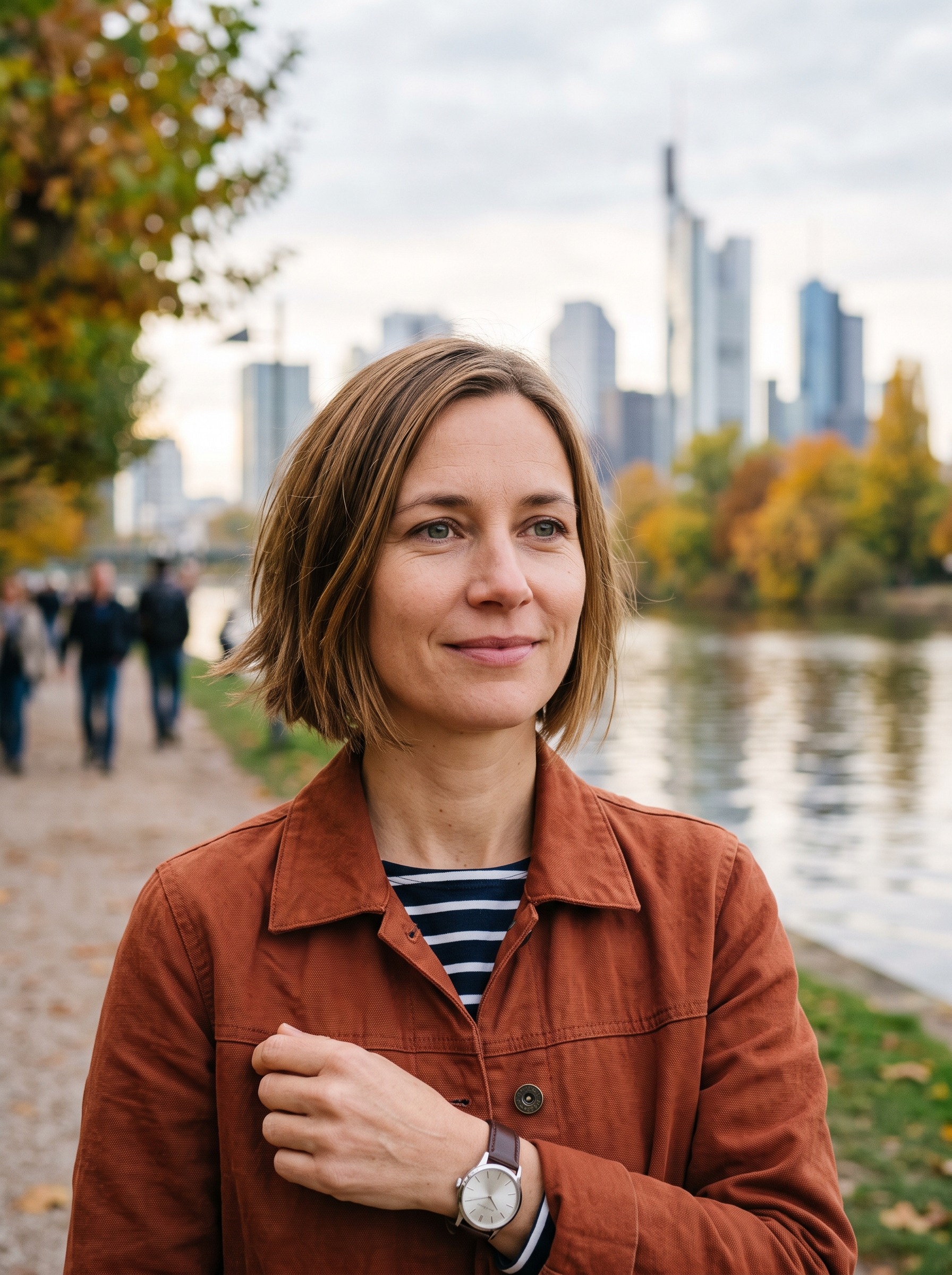
Down by the water, the Osthafen and the Mainufer path give you the view that explains why people keep coming back to this side of the city. The skyline is free, the river is free, and the composition is better than many paid viewpoints because it includes the sense of a working district rather than a stage set. At dusk, the tower, the water and the movement of the path together make Ostend look like a place in transition rather than a place that has already decided what it is.

For a more cultural stop, Naxoshalle on Waldschmidtstrasse is one of those conversions that feels honest about its past. The listed 1906/07 factory hall of the old Naxos-Union grinding-wheel works now houses Theater Willy Praml and hosts events including the Nippon Connection Japanese film festival. It is a reminder that Ostend’s industrial architecture is not being erased so much as repurposed, one hall at a time. And if you want the ECB from the inside rather than across the river, the bank runs free guided tours of its main building and the memorial. You need to book well ahead and bring a passport or national ID, but the visit is worth the planning if you care about how a city carries its difficult history.
{{ATTRACTIONS}}
Shopping
Shopping in Ostend is not the point, which is part of the point. Hanauer Landstrasse remains Germany’s highest-turnover car-dealership street, and the avenue’s showroom-lit scale gives the whole district a slightly functional, slightly futuristic feel. But the retail story here is not about fashion chains. It is about a practical ecosystem: design studios, coffee roasters and delis tucked between the metal and glass, and neighbourhood specialists on the residential streets around Wittelsbacherallee and Habsburgerallee.
For edible souvenirs, Gref-Völsings is the obvious stop. Its beef Rindswurst is as local as it gets, and if you want something that says Frankfurt without leaning on the usual clichés, that is it. Ostend is where you buy a coffee bag from a roaster and a sausage from a fifth-generation butcher. If you want a bigger shopping run, the Zeil is only a couple of U-Bahn stops west, and Bornheim’s Berger Strasse is a short tram ride north. Ostend itself prefers to stay useful.
Where to stay in Ostend
Ostend works well as a base because it gives you room without making you feel cut off. The standout for character is the 25hours Hotel The Goldman at Hanauer Landstrasse 127, a design hotel with around 97 rooms, art-driven interiors, an Isoletta restaurant, the Oost Bar and the rooftop Goldman Bar. It sits close to the ECB and gives you that east-side skyline feeling that makes the district’s transformation legible from breakfast to last drink.
For a more transport-first stay, INNSiDE by Meliá Frankfurt Ostend is right at Ostbahnhof, and the station area also has a solid cluster of good-value modern chains and hostels, including a B&B Hotel, an a&o hostel and an ibis budget. That makes the neighbourhood particularly sensible for families and cost-conscious trips. The best pockets are near Ostbahnhof for connections and the new-build blocks, or up around Ostpark and the leafy Wittelsbacherallee for a quieter, more residential feel a tram ride from the buzz. The trade-off is simple: you are not on the doorstep of the Altstadt or the Sachsenhausen cider taverns, but you are getting a better-value, more contemporary Frankfurt.
{{HOTELS}}
Getting around
Ostend is stitched together by Ostbahnhof, and that is the station you learn first. It is served by U6 and U7, plus the S-Bahn, regional trains and buses, with tram and bus stops at Ostbahnhof/Honsellstrasse. The Zoo stop on the same U-Bahn lines drops you at the western edge and the zoo itself, while Konstablerwache and Alte Oper are only a few minutes away by train. That means the centre is close enough to use casually, even if the district itself still feels spread out.
Along the harbour axis, tram line 11 is the easiest way to move between the ECB end and the docks, with a stop at Osthafenplatz right outside the 25hours Goldman. That tram is the neighbourhood’s quiet organiser. Ostend is not a place you cover end to end on foot unless you are in the mood for a long, slightly exposed walk. The avenues are broad, and the district rewards hopping rather than marching. Still, the riverside path and the Ostpark loop are both lovely on foot, especially when you want to understand the scale of the place rather than just cross it.
Frankfurt Airport is roughly 20 to 25 minutes away via the S-Bahn from the Hauptbahnhof, which is a short hop west, or by direct taxi. Safety is broadly fine and residential, with the usual big-city alertness around Ostbahnhof and the quieter dock streets late at night. Ostend is not a district that demands caution so much as attention. It is better read slowly, one avenue at a time.
FAQs
Is Ostend a good area to stay in Frankfurt?
Yes, if you want a good-value, well-connected base rather than a postcard old town. Ostend puts you a few U-Bahn minutes from the centre, with places like the 25hours Hotel The Goldman by the ECB and reliable budget options around Ostbahnhof, plus the zoo, Ostpark and the river close by. The trade-off is that it is a spread-out harbour-and-avenues district, so you are a short ride, not a walk, from the Altstadt and Sachsenhausen.
Can you visit the European Central Bank in Ostend?
Not freely, no, but the ECB does run free guided tours of its main building and the Grossmarkthalle memorial. You need to register well ahead and bring a passport or national ID card. The publicly accessible part of the memorial runs along the Philipp-Holzmann-Weg by the rail embankment, and the tower itself is a striking free photo stop from across the Main.
Where are the best skyline views in Ostend?
For the classic free shot, head to the Mainufer path or the Osthafen at dusk. If you want a drink with the view, the rooftop terrace at Oosten looks across the Main to the skyline, and the Goldman Bar at the 25hours The Goldman gives you east-side and ECB views. All three are strong alternatives to paying for a tower viewpoint.
What is Ostend best for?
Ostend is best for architecture and the ECB, riverside skyline views, third-wave coffee and wine bars, the zoo and Ostpark, and good-value modern hotels. It suits repeat visitors, families and anyone who likes watching a neighbourhood change in real time.