Jakarta guide
Kota Tua, Jakarta: the old Batavia quarter that still breathes
Jakarta’s most walkable historic district is all cobbles, colonial facades, museum rooms and canal-side coffee stops — best tackled in a single hot, happy half-day.

Step out of Jakarta Kota Station’s north exit and the city changes pace almost immediately: five minutes later you are on a broad cobbled square with white Dutch façades, buskers, and rental bikes lined up in candy colours like a child’s idea of a colonial district. Kota Tua is Jakarta at its most walkable and most theatrical, a place where the old Batavia grid still holds together long enough for you to feel the city’s history under your shoes. It is also gloriously, stubbornly imperfect — a little faded, a little hot, and much better for it.
What Kota Tua is known for
Kota Tua is the surviving heart of Batavia, the old walled Dutch East India Company town that grew into modern Jakarta. If the rest of the capital often feels like a place you have to fight your way through, this quarter offers a rare stretch of open ground and legible streets. The centre of gravity is Fatahillah Square, or Taman Fatahillah, a broad plaza the Dutch laid out as their civic centre and that Governor Ali Sadikin later declared a cultural-heritage zone in 1970. On weekdays it can be quiet enough to hear your own footsteps on the stone. On weekends, the whole thing comes alive with families, students in matching outfits, magicians, kuda lumping trance dancers and vendors frying kerak telor off carts.
Around the square, the buildings do the talking. The Jakarta History Museum, built in 1710 as the Stadhuis, anchors one side with its white bulk and old civic seriousness. The former church that now houses the Wayang Museum brings a different kind of drama, while the former Court of Justice, now the Fine Arts and Ceramics Museum, gives the square its formal symmetry. A little west, the Kali Besar — literally the Great Canal — stretches out as the other spine of the quarter, once dug so lighters could carry spices inland from ships moored at Sunda Kelapa. Along it sits Toko Merah, the deep-red 1730 mansion that still looks like it knows a few things it is not telling.

What makes Kota Tua work is not just the architecture, though there is plenty of that. It is the way the district compresses Jakarta’s layers into a few walkable blocks: Dutch civic power, maritime trade, Chinese-Indonesian commerce, present-day family outings, and the city’s ongoing attempt to preserve a historic quarter without turning it into a museum prop. The area is being slowly revitalised, with a low-emission zone already limiting traffic in the core and a bigger overhaul timed for Jakarta’s 500th anniversary in 2027. So yes, you may see scaffolding. That is part of the story too.
Things to do and what to see
Start with the Jakarta History Museum, because context is never wasted here. Entry is a token Rp 5,000, and it is open Tuesday to Sunday, roughly 9am to 3pm, closed on Mondays like most museums in the quarter. Inside are colonial-era furniture, VOC relics and early maps of Batavia, the sort of objects that make the old city feel less like a backdrop and more like a machine that once ran on trade, paperwork and power. The courtyard and the dungeons at the back are worth the loop; the building’s old bones are half the point.

A few doors away, the Wayang Museum changes the mood. Its collection of Javanese wayang kulit shadow puppets and Sundanese wayang golek rod puppets is a reminder that Jakarta’s history is not only Dutch and maritime; it is also performance, craft and oral tradition. On weekends it sometimes stages short live performances, which is exactly the kind of thing that can turn a museum stop into a small, memorable afternoon. Next door in spirit, if not in style, the Fine Arts and Ceramics Museum gathers Indonesian masters such as Raden Saleh and Affandi alongside centuries of ceramics. It is the sort of place that rewards slow looking, especially once the square outside starts to feel too bright and too loud.
Then there is the square itself, which deserves time rather than a quick photo and escape. Rent an ontel — one of the pastel single-speed bikes with a matching sun hat — from the stands in front of the History Museum for roughly Rp 20,000–30,000 an hour. The bikes are half transport, half costume, and yes, a little ridiculous. That is the charm. On a weekday morning, the square feels almost ceremonial; on a weekend afternoon, it becomes Jakarta in miniature, all family outing, performance, snack run and people-watching. The bells, the buskers, the hats, the heat: it is all part of the package.

If you want the district to widen out beyond the square, walk or take a short Grab north to Sunda Kelapa, the old harbour where towering wooden pinisi schooners still load cargo by hand. It is one of the most vivid living remnants of the spice-trade era, and the sight of those boats — all rigging, timber and weather — makes the old port feel less like a relic than a working archive. Nearby, the Menara Syahbandar, or Harbour Master’s Tower, offers views over the docks, while the Maritime Museum, set in restored VOC warehouses, ties the whole seafaring story together. Between them, these places remind you that Jakarta was built as much by water as by roads, and that the city’s old commercial logic still lingers in the harbour’s edges.

Where to eat & drink
Kota Tua does not behave like a neighbourhood that expects to feed you well, and then it quietly does. The set-piece is Café Batavia, on the west side of Fatahillah Square inside an 1805 building where dark wood, antique mirrors and thousands of framed black-and-white photographs crowd both floors. It has been a café since 1993, and in 2025 it refreshed its menu with heritage Indonesian and Indo-Dutch dishes — rendang, nasi goreng, the sous-vide tenderloin rendang — alongside a full cocktail list. It is pricier than the neighbours, at roughly Rp 50,000–200,000 a head, but you are paying for the room as much as the plate. Come for a drink upstairs at the Winston Churchill Bar, which grandly claims a 1996 “world’s best bar” citation, or time your visit for the ground-floor live jazz that runs most evenings. This is one of the rare places in Jakarta where lingering feels like the correct order of operations.

If you want the same atmosphere without the splurge, Kedai Seni Djakarté is the sensible, soulful answer. It sits on Jalan Pintu Besar Utara beside the Fatahillah Museum, a two-storey vintage kedai serving proper Soto Betawi, sate and warming bir pletok for around Rp 20,000–50,000. This is the sort of place that understands the value of a hot bowl and a cold room. The food is honest, the setting is old-school, and the prices are merciful.
For a different kind of refreshment, Acaraki is tucked in the Kerta Niaga building near the square and reinvents Indonesian jamu with coffee techniques. That sounds like a pitch until you taste it. The Golden Sparkling turmeric-tamarind soda and Saranti are the orders to make. In a district full of colonial surfaces, Acaraki brings the conversation back to local ingredients, local tonics and the city’s own habit of remixing old things into something unexpectedly modern.
Rode Winkel, on the ground floor of Toko Merah, is another good reason to follow the canal side rather than stay fixed on the square. Reopened as a café in late 2023, it gives you original marble floors and VOC-era details with your coffee. And if you want something moodier, Historia Food & Bar turns a former spice warehouse on Jalan Pintu Besar Utara into an Indonesian restaurant-bar where cocktails and nasi bakar share a 17th-century shell. Kota Tua may not be a dinner district, but it has enough good rooms to make an afternoon stretch without complaint.
Things to do, continued
The best way to do Kota Tua is to move in short, hot bursts and then duck indoors before the sun turns the stone into a griddle. That rhythm is not a flaw; it is the local operating system. Start with the museums, loop the square, take the ontel bikes for a spin, then push north toward the harbour if the weather and your legs allow. If you are a photographer, the district is generous with angles: the colonial facades around Fatahillah Square, the canal reflections along Kali Besar, the deep-red mass of Toko Merah, the working harbour at Sunda Kelapa. If you are a history traveller, the payoff is even better, because the narrative is all here in a handful of blocks.
{{ATTRACTIONS}}
Shopping & markets
Kota Tua is light on formal shopping, which is one of the reasons it still feels recognisably itself. You come here for history, not retail therapy, and the district does not pretend otherwise. Around the square, the edges are lined with stalls selling snacks, hats, cheap souvenirs and street portraits, the usual mix of opportunism and local hustle that follows a footfall-heavy public space. The revitalised Plaza BEOS area around Jakarta Kota Station is also being reworked into public and market space, which gives the station approach a little more life than a pure transit zone usually gets.
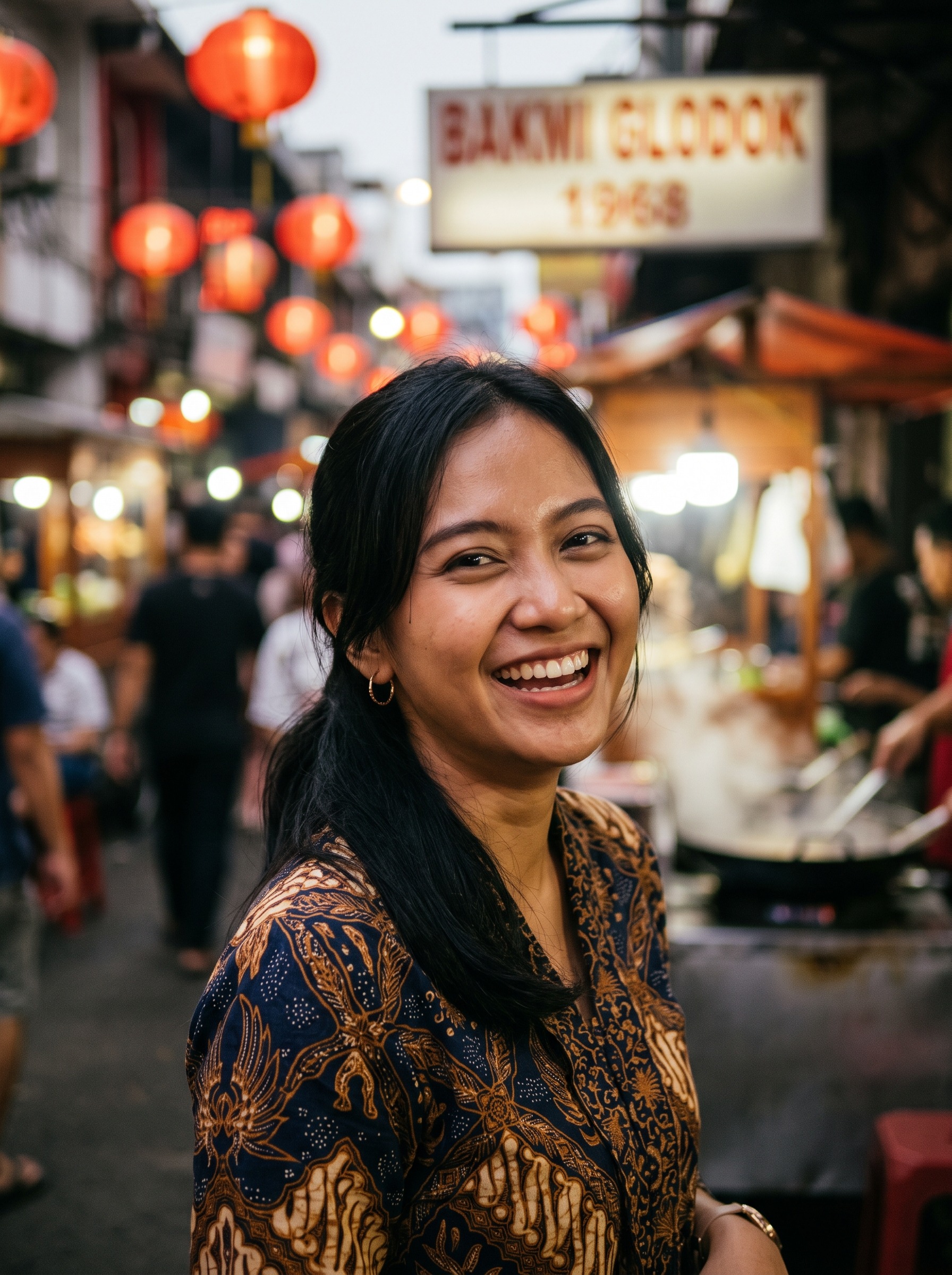
If you want actual market energy, keep walking or take a short ride south into Glodok, Jakarta’s Chinatown. The alleys of Petak Sembilan are where the day gets louder and more aromatic, with herbal shops, temple offerings, fresh produce and street food all jostling for space. It is only a five-to-ten-minute hop, but it changes the mood completely and turns a Kota Tua morning into a full day. Antique hunters, meanwhile, are better off heading to Jalan Surabaya flea market in Menteng; Kota Tua is not where you come to shop for old things, only to look at them in context.
Where to stay in Kota Tua
Be honest with yourself: almost nobody stays in Kota Tua, and there is little reason to force it. This is a daytime quarter that empties and quiets after the museums close, and the historic core has few hotels of note. Better-connected and more comfortable bases sit a short ride away — Menteng if you want leafy centrality near museums, Thamrin and Bundaran HI for international-brand hotels on the main boulevard close to the MRT, or SCBD/Senopati if you want dining and nightlife after dark. Kota Tua is best treated as a half-day trip, not a home base.
If you do want to wake up close to the old town for an early, crowd-free morning on the square, look at business hotels near Jalan Gajah Mada or around Jakarta Kota Station. They are functional rather than characterful, but they do put you minutes from the cobbles before the weekend crowds arrive. The live hotels below are the bookable options nearest this area.
{{HOTELS}}
Getting around
The easiest way in is the KRL Commuter Line to Jakarta Kota Station, still widely called Beos. From there it is about a five-minute, roughly 100-metre walk to Fatahillah Square — a cheap, air-conditioned ride that neatly sidesteps Jakarta’s traffic. If you are coming by bus, the nearest TransJakarta stop is Halte Kota on Corridor 1, and you can reach the square via the underpass to the station. Grab and Gojek cars and motorbike taxis are cheap and everywhere; use the apps rather than hailing on the street.
Inside Kota Tua, everything is walkable and increasingly car-limited thanks to the low-emission zone, though the pavements are uneven and the shade is scarce. That matters more than it sounds like it should. This is a place for short walks, long pauses and sensible timing. Go early if you can. Weekday mornings are gentler; weekend afternoons are crowded and shadeless. From the square, it is roughly 30–45 minutes to the Thamrin/Sudirman business core depending on traffic, and much of that is faster by train. To Soekarno-Hatta Airport, budget a full hour-plus; the Railink airport train from nearby stations is the reliable option when roads snarl.
Final word
Kota Tua is not Jakarta pretending to be Europe, despite the façades and the square and the old Dutch bones. It is Jakarta remembering itself in public. That is why it matters, and why it works so well for visitors: you can read the city here without needing to decode a thousand kilometres of sprawl. A museum, a canal, a harbour, a bowl of Soto Betawi, a drink at Café Batavia, a spin on an ontel bike, and you have the shape of the place.
The trick is to arrive early, move slowly, and leave before the heat and the crowds flatten the fun. Do that, and Kota Tua gives you something rare in this city: a half-day that feels complete.
FAQs
Is Kota Tua worth visiting in Jakarta?
Yes. It is the most concentrated dose of history and walkable sightseeing in Jakarta, and you can comfortably fit Fatahillah Square, a couple of museums, an ontel bike ride, a drink at Café Batavia and even Sunda Kelapa into a half-day. Weekday mornings are the sweet spot.
Should I stay in Kota Tua or just visit?
Just visit. Kota Tua is a daytime quarter that quiets down after the museums close, with few hotels in the historic core. Sleep in Menteng, Thamrin/Bundaran HI or SCBD/Senopati and come in for the day.
How do I get to Kota Tua and is it safe?
Take the KRL Commuter Line to Jakarta Kota (Beos) Station and walk about five minutes to Fatahillah Square, or use TransJakarta Corridor 1 to Halte Kota. It is safe and busy by day; keep an eye on your bag in weekend crowds and around the station, ignore fake guides, and avoid deserted side streets after dark.
What’s the best time to visit Kota Tua?
Go in the morning, ideally on a weekday. The square is cooler and calmer then, while weekend afternoons can get crowded, hot and shadeless.