Luxor guide
West Bank - Gurna (Qurna), Luxor: Where the Tombs Are the Neighbourhood
On Luxor’s West Bank, Gurna is the rare place where you sleep among the fields and wake within cycling distance of the Tombs of the Nobles, the Ramesseum and Hatshepsut’s cliff-side temple.
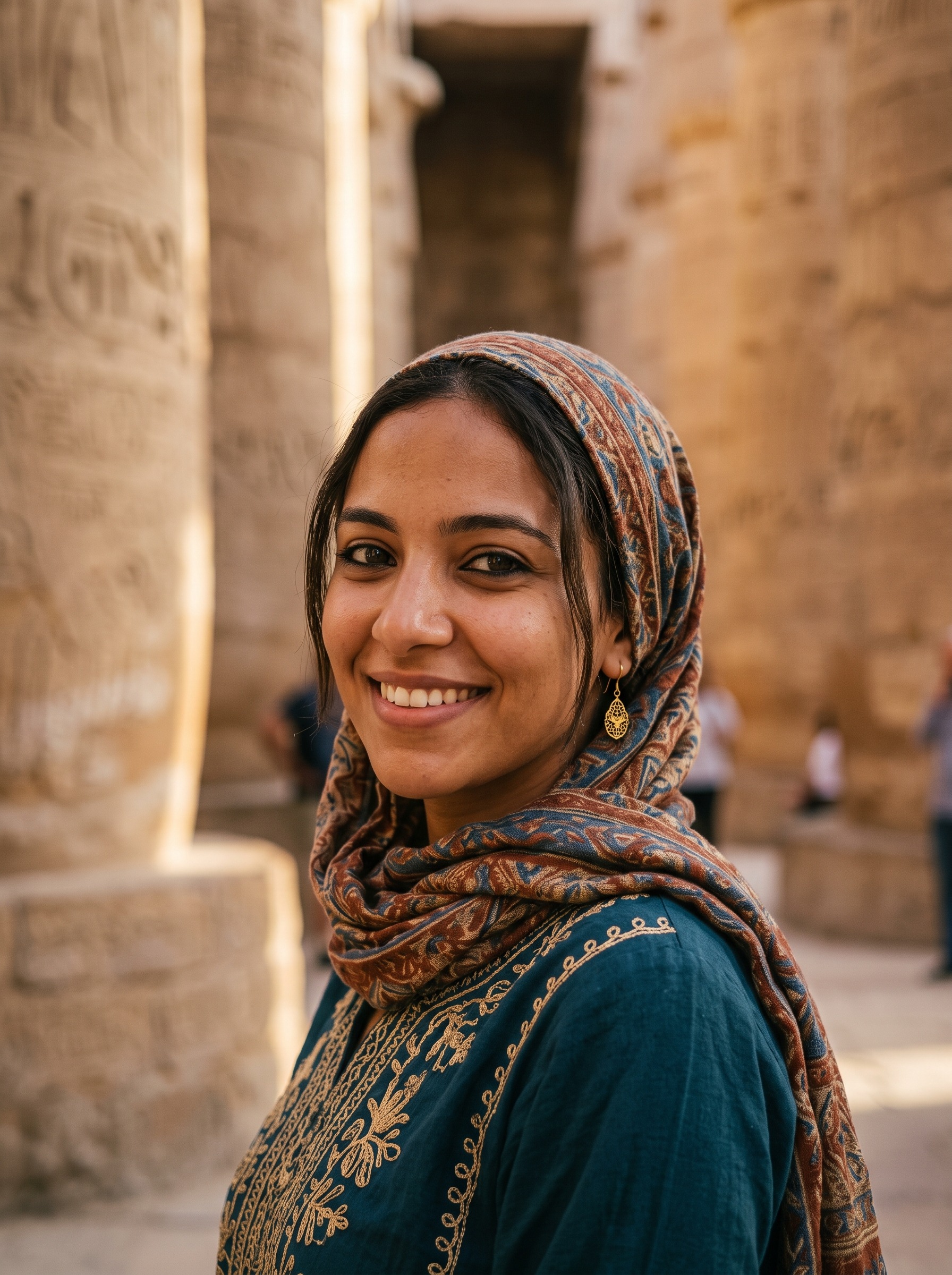

At dusk in Gurna, the last light goes soft over the sugarcane, and the donkey calls carry farther than any engine. The tombs are close enough that you can feel them before you see them: a low rise in the Theban hills, a cut of stone, a painted doorway, a road where a tour coach has already vanished. This is the West Bank neighbourhood where Luxor stops performing for the day and starts living again — in mudbrick houses, on bicycles, in fields of alfalfa and reeds, under a sky that seems to keep whatever it has seen.
What Gurna is known for
Gurna is not a district in the city sense so much as a lived-in edge of the Theban Necropolis, a scatter of villages stretched across the West Bank monument zone. Sheikh Abd el-Qurna is the name that matters first to archaeology obsessives: a slope riddled with the Tombs of the Nobles, more than 400 rock-cut chambers of viziers, mayors, scribes and officials from the New Kingdom. These are not the grand afterlife cathedrals of the Valley of the Kings. They are more intimate, more human, and in some ways more startling. Their walls keep daily life: tax records, banquets, grapevines, cattle, music, tribute, boats, grain. You come away feeling you have met the civilisation rather than admired its funerary costume.

That closeness to the past is also what made Gurna complicated. Families here long built houses directly over tombs, and for generations they excavated, farmed and survived among the monuments. Later, the antiquities authorities spent decades relocating residents to protect the paintings beneath them. Hassan Fathy’s New Gurna was the most famous result: a 1940s attempt to make a village that belonged to the place without sitting on its archaeology. It is one of those Luxor stories that still feels unfinished, which is part of why the neighbourhood has such a particular charge. Nothing here is sealed away behind a museum glass case. The ancient and the domestic still rub shoulders.
The bigger names are all around you, almost offensively close. The Ramesseum, Ramesses II’s mortuary temple, sits within bicycle distance, its shattered colossus lying in pieces like a king who has finally met time. The terraced Temple of Hatshepsut rises into the cliffs at Deir el-Bahari. Medinet Habu keeps its painted reliefs with a kind of stubborn clarity. Deir el-Medina preserves the artisans’ village where the tomb-builders themselves lived. And on the road in, the Colossi of Memnon stand free and exposed, as if they have been waiting through all the centuries for someone to slow down.
Gurna’s modern rhythm is agricultural and unhurried. Men on motorbikes pass with reeds strapped across the back. Children cycle to school. The call to prayer comes from the New Gurna mosque. Dust hangs in the bougainvillea. By afternoon, when the tour buses thin out, the place seems to exhale. There is no nightlife strip, no souk to drift through, no bar scene trying to pretend the desert is a city. What Gurna offers instead is something quieter and rarer: the luxury of proximity.
Things to do / what to see
The essential move in Gurna is to start where the neighbourhood begins to speak for itself: the Tombs of the Nobles at Sheikh Abd el-Qurna. They are the crowd-free counterpoint to the Valley of the Kings, and their paintings are a different kind of splendour — less about divine judgment, more about work, ceremony and the texture of ordinary high status in the New Kingdom. Seek out the Tomb of Sennefer (TT96), the so-called Tomb of the Vineyards, with its ceiling painted in hanging grapevines; the Tomb of Rekhmire (TT100), where a vizier’s world unfolds in 600-plus scenes of tax, justice and foreign tribute; and the banquet, music and farming scenes in the tombs of Nakht (TT52) and Menna (TT69), along with the exquisite reliefs of Ramose (TT55). These are the places that make you slow your voice without realising it.

A few grouped tickets cover the best of the tombs, and the experience is best early, before the heat and the coach traffic build elsewhere on the West Bank. You are not here to tick monuments off a list. You are here to stand in front of a wall where a scribe’s world still has colour in it.
From there, the broader West Bank opens out in easy, flat kilometres. The Ramesseum is one of the great stops here, not least because its toppled colossus of Ramesses II gave Shelley the image for Ozymandias. The temple is rarely crowded, which suits its mood: a ruin that still carries authority, even in fragments. Allow about 45 minutes and pay around 220 EGP as a foreign adult. It is the kind of place that rewards a longer look than the guidebooks usually grant.

The Temple of Hatshepsut at Deir el-Bahari is the West Bank’s most theatrical approach to monumentality, three terraces climbing into the cliff face with a confidence that still reads as modern. Foreign adults pay around 440 EGP. The building is famous for a reason, but not because it is coasting on its name; the drama is real, and the cliff behind it makes the whole thing feel less like architecture and more like a negotiation with geology.
Medinet Habu is the quieter triumph, often called the best-preserved temple on the West Bank. Its deeply cut painted reliefs still hold their crispness, and the crowds are lighter than at the headline sites. That matters. So does Deir el-Medina, the walled village of the artisans who built the royal tombs. It is intimate, human-scaled, and full of beautifully painted craftsmen’s tombs — a reminder that the valley’s masterpieces were made by workers who knew stone from the inside.
Don't skip the Howard Carter House near the Valley of the Kings turnoff. The restored mudbrick home of Tutankhamun’s discoverer is now a museum, and the full facsimile of the tomb in the garden gives the place an odd, almost domestic intimacy. Here is archaeology as biography rather than spectacle.
And then there is New Gurna, Hassan Fathy’s pioneering mudbrick village. Restored by UNESCO in 2022, its mosque, khan and theatre can be visited through the local sustainable-architecture centre. It is one of the clearest windows into the 20th-century attempt to rethink how people should live beside antiquity, and it still feels alive rather than embalmed.

{{ATTRACTIONS}}
If you come to Gurna for one thing and one thing only, make it the sunrise hot-air balloon. The fields below are already pale with morning when the baskets rise, and the Theban hills catch the first gold before the road traffic has properly woken. It is a tourist ritual, yes, but in this landscape the cliché still earns its keep.
Where to eat & drink
Dining in Gurna is not about choice; it is about one or two places done with conviction, and a lot of guesthouse cooking that feels like someone has opened the family kitchen to you. The standout, by a distance, is the Marsam Hotel garden restaurant near the ticket-office roundabout in Qurnat Murai. Marsam began as a century-old archaeologists’ dig house and remains one of the loveliest places to eat anywhere in Luxor. The garden is shaded by hollyhocks and sunflowers. There is no fixed menu. Instead, the kitchen serves a daily-changing set choice of chicken, meat, fish or vegetarian, with fresh salads, rice, vegetables and bread pulled from the on-site oven. The fish comes from Lake Nasser, the produce is mostly organic and local, and there is no deep-frozen convenience food in sight. People call it the best food on the West Bank for a reason, and the 4.6 average across hundreds of ratings is not a fluke.

It is worth booking a lunch table here even if you are sleeping elsewhere. That is not a line I use lightly. In a neighbourhood where food is often an afterthought to the monuments, Marsam makes the meal part of the memory.
At the far end of the scale sits Al Moudira, the desert-edge palace hotel that opens its kitchens to non-residents by reservation. Its Ottoman Hall does an ambitious Mediterranean–Middle Eastern menu; Il Forno & Pool Bar turns out wood-fired pizza in a palm grove; and Khan Al Moudira serves Egyptian classics among Cairo antiques around an Ottoman marble fountain. The hotel farms much of its own produce, and in 2025 it was named one of the world’s most beautiful hotels, a Prix Versailles laureate. That is the sort of accolade that can sound inflated until you walk through the place and realise the setting is doing half the work and the kitchen the rest.
For something simpler, guesthouses like Nour El Gourna and Sunflower Guest House serve home-cooked Egyptian food. Nour El Gourna, opposite the ticket booths, is especially easy to imagine after a long morning in the tombs: mudbrick walls, fresh vegetables, local bread, the sense that the meal is there to steady you rather than impress you.
Where to stay in Gurna
Gurna is where you trade convenience for atmosphere and pole-position access to the tombs. That is the bargain, and it is a good one if you know what you are buying. The most characterful choice is the Marsam Hotel, the West Bank’s oldest guesthouse, with simple mudbrick and stone rooms, a famous garden, and a clientele that tends toward Egyptologists, artists and independent travellers rather than package-tour drift. The plainer white house rooms with shared bathrooms are the cheapest; the newer Italian House rooms are more comfortable, some with air-conditioning and en-suites. It feels lived-in, not polished to death.
Nour El Gourna is the friendliest sort of practical stay: a small family-run mudbrick guesthouse opposite the ticket booths, walkable to the tombs and temples, with cool upstairs rooms and generous home cooking. Sunflower Guest House is another sensible base, clean and spacious, with a rooftop bar and free breakfast, well placed for both banks. At the top end, Al Moudira is the West Bank’s only true luxury address: 54 individually decorated rooms, gardens, a pool and serious food, out where the farmland meets the desert. Book ahead in the cool high season, roughly October to April, because rooms in Gurna are limited and the best ones go first.
{{HOTELS}}
Getting around
Gurna is genuinely rural, so transport is something you plan rather than assume. The classic arrival is the cheap public ferry from the East Bank Corniche to the West Bank landing at Al-Gezira, then a short taxi or guesthouse pickup onward. Many guesthouses will collect you, which is useful because taxis and the odd tuk-tuk exist but are sparse, and there is no reliable public transport between the villages. Agree a fare before setting off. Arrange your dawn balloon pickup and any airport transfer in advance. Luxor International Airport is on the East Bank, roughly 45 minutes away including the river crossing.
Once you are here, the bicycle is the great equaliser. The Ramesseum, Medinet Habu, Deir el-Medina, the Colossi of Memnon and the Tombs of the Nobles all sit within a flat few kilometres of one another, and most guesthouses rent or lend bikes. That is the West Bank at its best: not a place to be driven through in air-conditioned comfort, but a landscape to move across at the speed of a thought. The central ticket office near the Colossi of Memnon is where you buy entry for the temples, Deir el-Medina and the Tombs of the Nobles, so pass it first and build your day around it.
The practical truth of Gurna is simple. It is one of the calmest, friendliest parts of Luxor, and one of the most useful if your priority is the archaeology. It is also hot, sparse and low on services. Carry water. Carry cash. Do not arrive expecting the East Bank’s convenience to have crossed the river with you. Gurna gives you something else instead: fields at dawn, tombs before breakfast, and the feeling that the West Bank is not a sightseeing zone but a place people still live inside.
FAQs
Is Gurna a good area to stay in Luxor?
Yes, if your priority is the West Bank monuments and a quiet, rural, atmospheric base. You can walk or cycle to the Tombs of the Nobles, the Ramesseum, Medinet Habu and Deir el-Medina, and wake to balloons over the fields. It is not the place for nightlife, shopping or having lots of restaurants and services on your doorstep; for that, the East Bank Downtown area is a ferry ride away.
Is Gurna safe?
Yes. Gurna is a working farming community and one of the calmer, friendlier parts of Luxor, with very little crime. The real issues are practical: transport is sparse, shops, ATMs and pharmacies are minimal, and it gets very hot, so bring water, cash and a plan for taxis or pickups.
Can I eat at the Marsam Hotel if I’m not staying there?
Yes. The Marsam’s garden restaurant welcomes non-guests and is one of the best-loved places to eat on the West Bank. There’s no fixed menu; the daily set choice of chicken, meat, fish or vegetarian comes with salads, rice, vegetables and oven-baked bread, using mostly organic local produce and fish from Lake Nasser. It’s smart to reserve lunch ahead.
How do I get around Gurna and the West Bank sites?
The easiest way is by bicycle once you’re on the West Bank. The Ramesseum, Medinet Habu, Deir el-Medina, the Colossi of Memnon and the Tombs of the Nobles are all within a flat few kilometres. For arrival, take the public ferry from the East Bank to Al-Gezira, then a taxi or guesthouse pickup.