Naples guide
Quartieri Spagnoli, Naples: loud alleys, murals and fried pizza
A steep sixteenth-century grid off Via Toledo where Maradona is shrine, the spritz costs a euro, and Naples speaks at full volume.
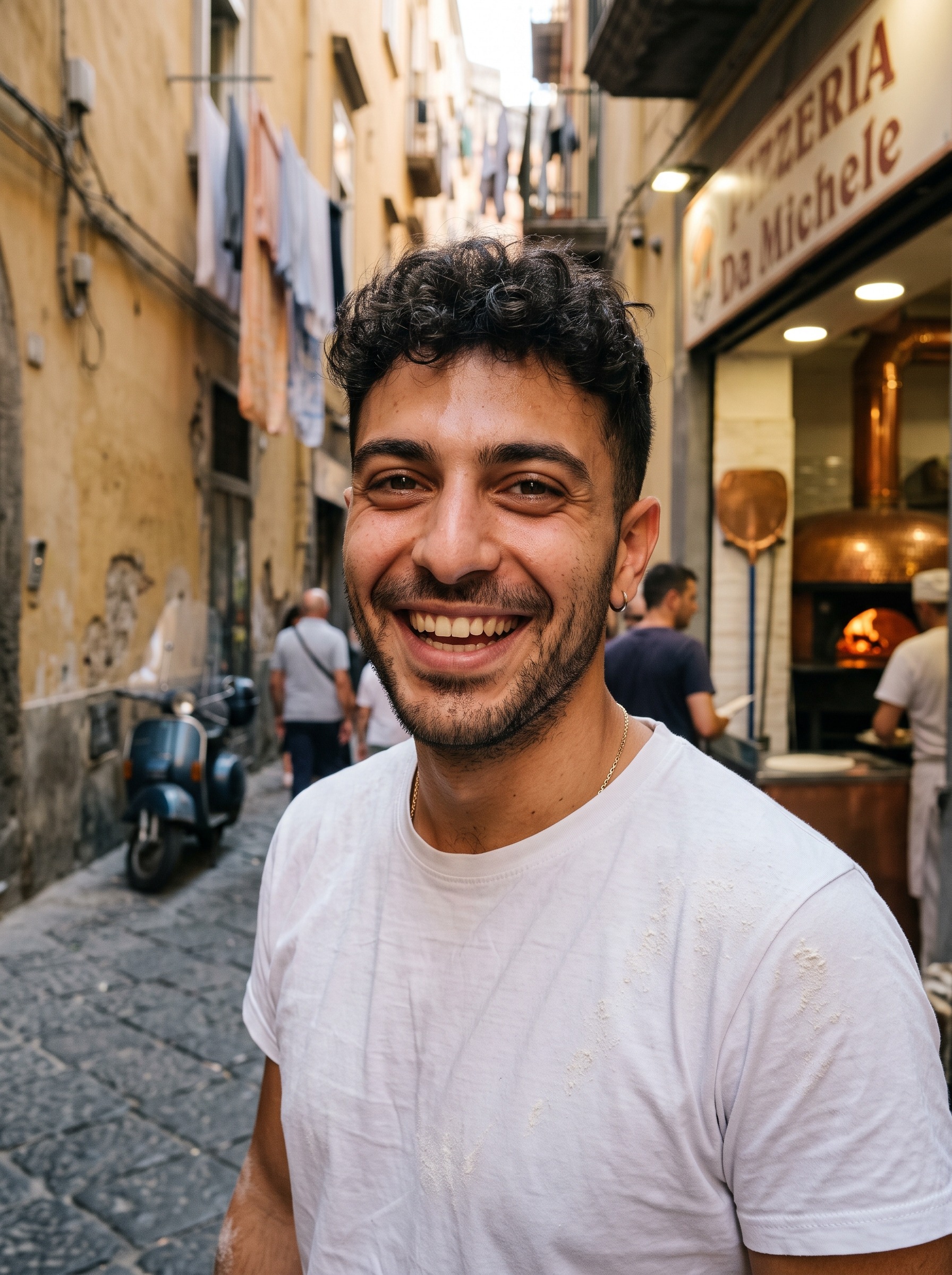

Climb one block west off Via Toledo and the mood changes in a blink: the pavement pitches uphill, the sky thins to a strip, and a scooter can brush past your elbow if you’re not paying attention. That’s the Quartieri Spagnoli, a sixteenth-century soldiers’ quarter turned working neighbourhood, all staircases, bassi, shrines, laundry and noise. It is not polished. That is the point. The place comes at you in layers — fried dough, football devotion, cheap drinks, mural paint, a shouted name bouncing off four floors of balconies — and if you want a tidied-up Naples, keep walking. If you want the real thing, start here.
What the Quartieri Spagnoli is known for
The first thing to understand is the shape of the place. The Quartieri were laid out in the 1530s to barrack Spanish troops, and the plan still holds: a steep, regular ladder of vicoli climbing toward the Vomero slope, so tight that opposite balconies almost meet. You do not look at this quarter from a distance; you read it on foot, neck craned, catching the signs of life at street level — a kitchen door open on the pavement, a shrine to Padre Pio, a caged canary, a football flag, a phone speaker blasting neomelodic songs. The bassi, those single-room homes opening straight onto the alley, make the street feel inhabited in the old sense, not performed. People are cooking, arguing, hanging laundry, calling up to one another. The quarter is dense enough to feel like a pressure system.

That same density is why the neighbourhood has become a magnet. It was once known mainly for rough edges, and locals still have practical advice: keep your phone in your pocket, your bag on the wall side. Fair enough. But the real texture now is a place mid-transformation, where €1 spritz bars fill with students, street-art walks thread through the alleys, and visitors come specifically for the giant Diego Maradona mural. This is a quarter that makes its own theatre out of daily life. It is loud, unfiltered and completely itself.
The big draw is the street art, and the biggest of all is Largo Maradona on Via Emanuele De Deo. The mural is three storeys high, first painted in 1990 and restored after Maradona’s death, and the square around it has become a shrine ringed with scarves, candles and photos. It is not just a picture; it is a local altar, and it deserves a minute, not a selfie sprint. Worth knowing before you go: through late 2025 the little square was repeatedly tarped off and reopened during a dispute between local traders and the city over the food carts there, so access can be blocked on any given day.

The mural has pulled the eye, but it has not emptied the rest of the quarter. A Sophia Loren portrait waits on Vico San Liborio, and Via Montesilvano runs like a street-art corridor locals call the “Montmartre of Naples,” with work by Neapolitan artists including Cyop&Kaf. Walk that lane slowly. The walls are not blank surfaces here; they are arguments, tributes, jokes, declarations. In a city that already speaks with its hands, the Quartieri has learned to speak with spray paint too.
Where to eat & drink
Eat where the queues are and you rarely go wrong, especially in the Quartieri. This is one of the best-value eating quarters in Naples, and the food is not trying to impress anyone. It is trying to feed you properly.
Start with Osteria della Mattonella on Via Giovanni Nicotera 13, the benchmark trattoria of the quarter. It’s a tiny room lined with hand-painted majolica tiles, open since the late 1970s, and the dish people talk about is the slow-cooked Genovese — onion-and-beef ragù over ziti — which regulars rate the best in the city. Book ahead. It closes on Wednesdays. That is the rhythm here: old-school, serious, no nonsense.

For pizza, Pizzeria Speranzella on Via S. Mattia 6 keeps things in the right register: proper wood-fired Neapolitan pies, prices in single figures, no theatrical markup. This is the sort of place that reminds you Naples does not need to apologize for being direct. The dough comes blistered, the room is narrow, and the bill stays sane.
The street-food essential is pizza fritta, and the shrine for it is Pizza Fritta da Fernanda on Via Speranzella. It’s a friggitoria run out of a ground-floor basso, cash only, daytime hours, and it does exactly what it says on the tin: a dough pocket stuffed with ricotta, provola and pork cracklings, then deep-fried. No ceremony, just heat and fat and the kind of satisfaction that makes you forget you were ever planning a “light lunch.”
A few steps from the Maradona mural, Bar Aloia on Via Emanuele De Deo 9 has been a neighbourhood fixture since 1980. Come for coffee, stand your ground, and watch the alley work itself out around you. In the Quartieri, a bar is rarely just a bar; it is a perch, a meeting point, a place to catch the pulse before you move on.
One honest note on a local legend: Trattoria da Nennella left the Quartieri in December 2023 after 74 years and now sits just outside the quarter on Piazza Carità. Still worth it, but no longer on these alleys. That matters, because this neighbourhood has a habit of turning institutions into folklore. Better to know where the folklore has actually moved.
Going out
Nightlife here is street nightlife. You drink standing up, in the alley, in a plastic cup, with the whole lane in on the transaction. The phenomenon everyone talks about is the €1 spritz, and its home base is Cammarota Spritz on Vico Lungo Teatro Nuovo 31. It is bare-bones, packed, and famous for a reason: Aperol spritz for a single euro, most evenings spilling students and artists across the lane from early evening until nearly midnight. Ask specifically for the spritz piccolo or you’ll be handed a larger, pricier size. That is the sort of detail that separates the locals from the day-trippers.

If you want something calmer and more grown-up, slip over to Ex Falegnameria on Vico Lungo del Gelso 73, a cocktail and natural-wine bar in a former carpentry workshop. It gives the quarter a different register — less shouty, more measured — without pretending the neighbourhood is anything other than what it is. This is not a club district. There are few late DJ bars up in the vicoli, so the pattern is a slow crawl between packed spritz corners. When you want a proper club or live-music night, you drift down to Via Toledo and the seafront instead.
That, honestly, is part of the charm. The Quartieri does not try to be a nightlife “scene” in the glossy sense. It is a place where the evening leaks into the street because the street is where life already happens.
Things to do / what to see
The quarter is the activity. The best thing to do is simply walk it uphill, ideally with a local guide who can read the murals, the shrines and the social codes for you. Several small-group street-art walks start from Via Toledo, which makes sense: the edge of the neighbourhood is busy, obvious, and then suddenly you are inside the maze.
Make Largo Maradona on Via Emanuele De Deo your anchor point. Even with the on-off closures of 2025, it remains the quarter’s biggest draw and a genuine pilgrimage site rather than a photo backdrop. Stand there long enough and you’ll see the difference. People do not just pose; they pause. They cross themselves. They leave things. They talk quietly. In a city that can turn any object into a symbol, this one has become a civic shrine.
From there, hunt the Sophia Loren mural on Vico San Liborio and follow Via Montesilvano, the street-art corridor nicknamed the “Montmartre of Naples,” past portraits of Neapolitan cultural figures. The point is not to tick off murals like stamps. The point is to let the quarter reveal how it honours its own icons — footballer, film star, local artist, saint, neighbour.
For a rooftop-of-the-neighbourhood moment, the stepped Pedamentina and the funicular from nearby Montesanto both climb to the Vomero balcony for the classic panorama over the bay and Vesuvius. That view is the release valve after the tightness below. You feel the city open out. The bay arrives. Vesuvius sits there like it has all the time in the world.
And don’t overlook the theatrical Toledo metro station on the quarter’s edge, repeatedly ranked among Europe’s most beautiful, with its blue mosaic “Crater de Luz” light shaft. Even if you are not catching a train, it is worth the detour. Naples loves a dramatic entrance, and this station delivers one underground.

{{ATTRACTIONS}}
Shopping & markets
The Quartieri itself is not a boutique district. The streets are more likely to sell household bits, football shirts and religious knick-knacks than anything polished, and that is fine. The real shopping energy comes from the edges.
Via Toledo is the pedestrianised spine along the eastern side, Naples’ busiest high street, lined with chain stores, shoe shops and gelaterie. It is good for an evening passeggiata, less because of what you buy than because of how it lets you move — out of the narrow alleys and into a broader city rhythm for a while.
A few blocks north-west and you hit La Pignasecca, one of Naples’ oldest street markets. This is where you want to hear the city at full volume in the morning: fish, greens, fruit, friggitorie, paper cones of fried fish and vegetables — cuoppi — handed over to be eaten on the move. Come early for the full noise of it. That is when the market is most itself.
Between the two, keep an eye out for old-school Neapolitan artisan trades still clinging to the streets around Via Toledo — tailors, umbrella-makers, the kind of craft that survives because the city has not yet managed to forget it. And if you see a pastry counter with warm sfogliatelle, stop. The crisp shell-shaped ricotta pastry is a Naples signature for a reason, and it tastes better when you are standing on a pavement with the market still shouting around you.
Where to stay in the Quartieri Spagnoli
Staying here means B&Bs, guesthouses and self-catering rooms rather than big hotels. The buildings are historic apartment blocks, so expect stairs, sometimes no lift, and rooms carved out of old flats. That is the trade-off: price and position. You are a two-minute walk from Via Toledo and the Toledo metro, and firmly inside real Neapolitan life, for less than you’d pay in Chiaia or on the seafront.
Pick your street carefully. The lower alleys nearest Via Toledo, around Vico Lungo del Gelso and Vico Lungo Teatro Nuovo, are the most convenient but also the loudest, especially where the €1-spritz crowds gather. A room a little higher up the hill, or on a quieter parallel lane, buys you sleep. Look for a well-reviewed, well-secured place with 24-hour host contact, and ask specifically about noise and how many flights of stairs you’re facing. This is not the quarter for surprises after dark if you were hoping for silence.
{{HOTELS}}
Getting around
The Quartieri is compact but steep — a walking-and-stairs neighbourhood, not a driving one, and you’ll do most of it on foot. The key transit point is Toledo station on Metro Line 1, on the eastern edge. Take the Montecalvario exit and its escalators drop you straight into the alleys. Line 1 links you to the central station at Garibaldi in a few stops and up to Vomero.
Montesanto, just north-west, adds a Line 2 stop plus the Cumana and Circumflegrea regional railways and the funicular up to Vomero. That makes it the other useful hinge for moving around the city without wrestling the quarter’s stairs.
For the airport, Capodichino is about 15–20 minutes by taxi or the Alibus airport shuttle, which runs from Via Toledo’s lower end and the port; there’s no metro link to the airport. Skip taxis inside the quarter — the vicoli are too narrow and stepped for cars, and walking is almost always faster.
If you want the Quartieri at its best, move early, move on foot, and let the alleys do the work. This is not a neighbourhood that rewards rushing. It rewards attention, appetite and a bit of nerve.
FAQs
Is the Quartieri Spagnoli a good area to stay in Naples?
For the right traveller, yes. It’s central, cheap and full of atmosphere — two minutes from Via Toledo and the metro, surrounded by great trattorias and bars. The caveats are noise and stairs: it’s a dense, hilly quarter of old apartment buildings, so choose a well-reviewed place a little up the hill or on a quiet lane if you value sleep, and expect a livelier, scruffier scene than Chiaia or the seafront.
Is the Quartieri Spagnoli safe for tourists?
It’s far safer than its old reputation suggests and is visited by huge numbers of people every day, especially around Via Toledo, the food streets and the Maradona mural. Petty theft is the real risk, not violence: keep your phone in your pocket, wear bags on the wall side, and stick to busier, better-lit lanes after dark. Exploring by day and early evening is comfortable for most visitors; use normal big-city caution on quiet alleys late at night.
Can you still see the Maradona mural in the Quartieri Spagnoli?
Usually yes — the huge mural on Via Emanuele De Deo, at Largo Maradona, is one of the quarter’s top sights and a genuine local shrine. Be aware that through 2025 the small square around it was repeatedly closed off and reopened during a dispute between local traders and the city over the food carts there, so on some days it may be tarped or blocked. Check locally before making a special trip, and treat it as a place of pilgrimage rather than just a photo stop.
What should I eat first in the Quartieri Spagnoli?
Go straight for pizza fritta at Pizza Fritta da Fernanda, a proper Genovese at Osteria della Mattonella, or a wood-fired pizza at Pizzeria Speranzella. If you’re wandering the markets, grab a cuoppo from La Pignasecca and a coffee at Bar Aloia after.