Naples guide
Rione Sanità, Naples: The Hill Quarter That Learned to Rebuild Itself
Beneath Capodimonte, Naples’ Sanità still hums with market noise, catacombs, pizza fritta and a stubborn, local-led regeneration that feels earned, not packaged.
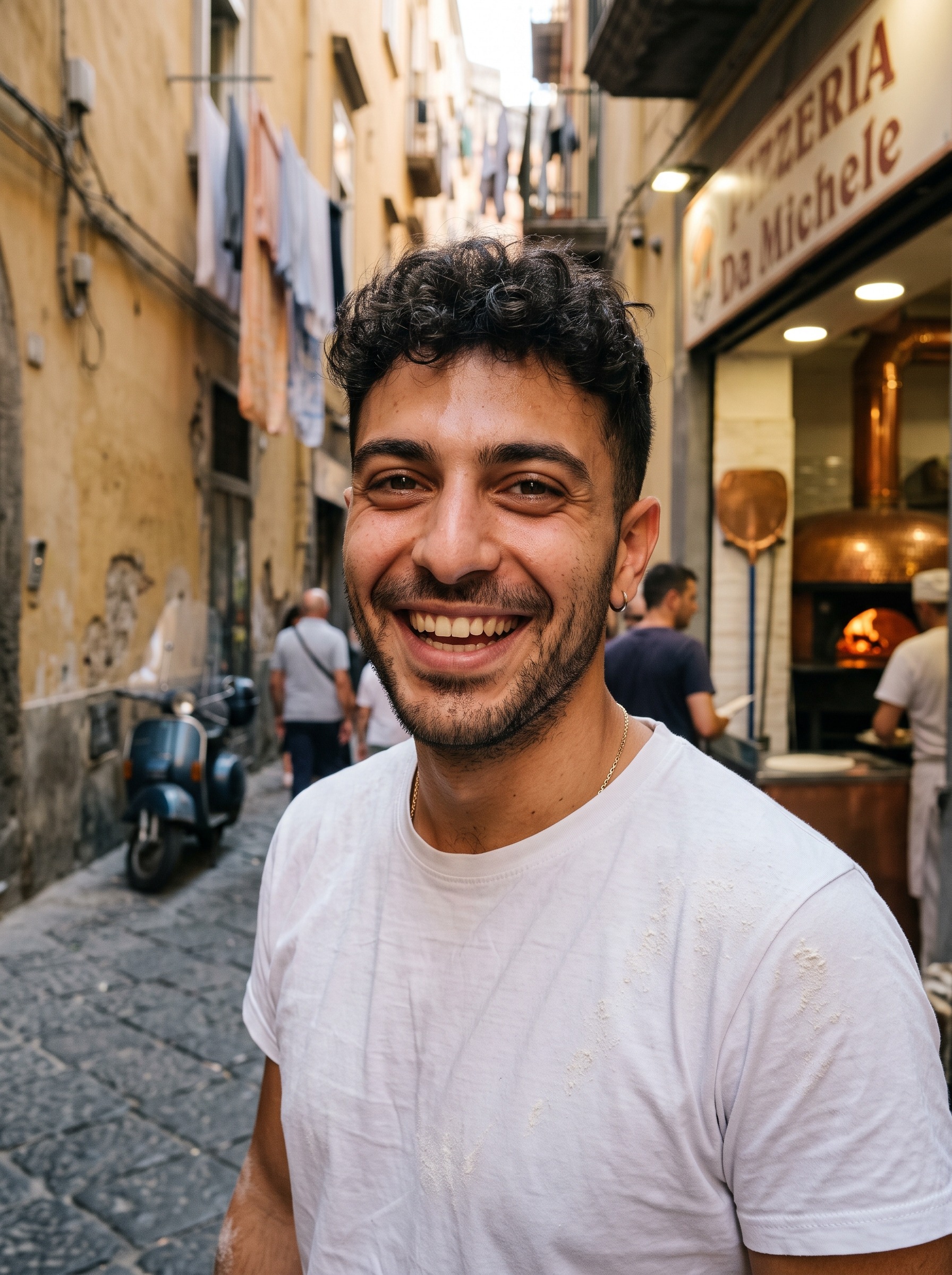

Two decades ago, taxis wouldn’t drive into the Sanità after dark. Now people come down the hill for a Michelin-listed pizzaiolo, a church reborn in marble, and catacombs run by local kids who turned a sealed-off quarter into one of Naples’ most compelling walks. The place still feels rough-edged, still loud, still gloriously unpolished. That’s the point.
What Rione Sanità is known for
The Sanità sits in a bowl below Capodimonte, and you feel that geography before you understand it. The quarter is cut off from the smart city above by the Ponte della Sanità, the viaduct the Bourbons threw across the gap in 1809 so royalty wouldn’t have to pass through. That old insult, that physical separation, shaped everything that came after: a working-class district of baroque palazzi, fruit stalls, votive shrines, scooters, washing lines, and alleyways so tight a Vespa seems to have to ask permission.
The name itself means health, from the good air and the healing reputation early Christians attached to the catacombs in the tufa here. That underground world is the reason the neighbourhood exists on the map at all, and the reason it’s back there now in a different register. For most of the 20th century, the Sanità was shorthand for poverty and crime; guidebooks skipped it, and visitors did too. Then, in 2006, local young people backed by the parish priest Antonio Loffredo took over the neglected Catacombe di San Gennaro and turned them into a professionally run visitor site. That cooperative, La Paranza, now employs dozens of people and has become the model for the quarter’s wider rebirth. This is the key thing to understand here: the regeneration is home-grown. The money loops back into training and jobs. It reads as lived-in rather than curated.
The Sanità also gave Naples Totò, born at Via Santa Maria Antesaecula 109, where a plaque marks the building. The flat itself opens only on his birth and death anniversaries, which feels exactly right for a neighbourhood that prefers memory to monumentality. Add the baroque staircases of Ferdinando Sanfelice, a dense street-art trail, and the reborn Jago Museum, and you have a square kilometre that carries more history than many whole districts.

On mornings around Via Vergini and Via Arena della Sanità, the quarter performs itself at full volume. Vendors shout prices for friarielli, ricotta and Annurca apples; espresso is drunk standing at the bar for a euro and change; church bells cut through the dialect chatter. It’s a place that has decided, collectively and stubbornly, to reinvent itself without polishing away the grit. You are a guest here, not a customer in a stage set, and the warmth — plus the occasional wariness — is real.
Where to eat & drink
Via Arena della Sanità does an unreasonable amount of culinary heavy lifting. Locals treat it like the quarter’s canteen, and if you spend an hour there you start to understand why. At number 7 bis, Concettina ai Tre Santi is the reason many people come to the Sanità at all. Ciro Oliva, a fourth-generation pizzaiolo, has turned his family’s 1950s neighbourhood pizzeria into a Michelin Guide-listed kitchen obsessed with tiny local producers. This is not just a margherita stop; the place works through tasting menus of pizzas and fried starters, with prices well above the €5 street standard, and it does so with the confidence of a room that knows exactly who it is.

A few doors down at number 27, Isabella De Cham Pizza Fritta is doing the old thing properly. This is Naples’ benchmark fried pizza, made by an all-women team: dough parcels stuffed with ricotta, provola, cicoli and black pepper, then deep-fried to order. In the 2026 Pizzerie d’Italia guide it earned Three Spicchi, which is a fancy way of saying what the queue already tells you — people come here because the crust is right and the filling is generous.
Sweet things are practically a religion in the Sanità. Pasticceria Poppella, at Via Arena della Sanità 29, invented the fiocco di neve, that soft brioche bun stuffed with a cloud of milk-and-ricotta cream. Eat it before mid-morning if you can, because they sell out. That’s not a marketing line; that’s just how it is. In summer 2025, the family opened Annarè a few metres away, turning the same cream into gelato alongside pastiera and tarallo scoops. It’s a neat little neighbourhood move: one idea, translated twice, in pastry and in ice cream.

For coffee with a purpose, Lazzarelle is the one to know. The cooperative roasts and pours espresso made by women who trained inside the Pozzuoli prison. That matters here, because the Sanità’s regeneration is built on social enterprises rather than slogans. You can taste the seriousness in the coffee, and you can feel the politics in the room without anyone needing to announce it.
Going out
The Sanità is not a late-night quarter, and it’s honest about that. The clubbing energy lives up in Vomero and over in Chiaia. What the Sanità has instead is aperitivo with elbows out, a warm spilling-into-the-street scene that feels like an extension of the pavement rather than an event.
The anchor is Antica Cantina Sepe on Via Vergini 55, a former grocery run by the Sepe family that now works as a wine shop by day and a buzzing bar by evening. The list leans hard into Campanian bottles — Aglianico, Falanghina, Lacryma Christi off the slopes of Vesuvius — and Thursday nights are the ritual: live music from around 7pm and a fried-pizza truck parked outside. That’s the Sanità in one sentence, really: a room that remembers being a shop, a street that knows how to become a party without pretending to be a club.

If you want something smaller and scruffier in the best way, Sciò is tucked into Vico Buongiorno just off the main drag. It’s a tiny bar hemmed in by street art, the sort of place where you sit outside with a spritz or a beer and watch the alley go by. No performance, no fuss, just the street doing what streets do when people trust them.
Evenings here often revolve around culture rather than bottles — a play, a concert in Piazza Sanità, or a passeggiata along Via Vergini before a late Neapolitan dinner, which rarely starts before 9pm. That timing matters. The neighbourhood doesn’t rush itself for anybody.
Things to do / what to see
Start underground. The Catacombe di San Gennaro, at Via Capodimonte 13, are the headline. They’re two levels of tufa galleries holding 2nd-to-5th-century frescoes, early Christian mosaics and the original resting place of Naples’ patron saint. They’re run by La Paranza, the youth cooperative whose ticket money funds local jobs, which is exactly the kind of regeneration story that sounds neat until you realise it’s actually working.
A single ticket also covers the Catacombe di San Gaudioso, reached through the crypt of the Basilica di Santa Maria della Sanità on Piazza Sanità. The basilica itself is worth the pause: baroque, emphatic, and crowned by a yellow-and-green majolica dome that you can spot before you’re properly inside the square. Book ahead at catacombedinapoli.it, and remember the sites are closed on Wednesdays.

Then go older and stranger. The Ipogeo dei Cristallini on Via dei Cristallini 133 opened to the public only recently, and it feels like a secret that has decided to speak. These are exceptionally preserved Hellenistic-Greek tombs, painted with Dionysus and Medusa, hidden beneath a private palazzo. Naples does this sort of thing better than almost anywhere: it keeps whole worlds stacked under the floorboards.
Above ground, the Jago Museum inside the restored 17th-century church of Sant’Aspreno ai Crociferi, at Piazzetta Crociferi 4, gives the quarter a contemporary edge without breaking the mood. Jago’s hyperreal marble sculptures, including Figlio Velato, are a Sanità answer to the famous Veiled Christ — not a copy, not a provocation, but a serious piece of local ambition carved in stone.
And then there is the long-awaited Cimitero delle Fontanelle at Via Fontanelle 80, the vast tufa ossuary stacked with thousands of skulls and tied to Naples’ cult of the anime pezzentelle, the adopted poor souls. It reopened on 19 April 2026 after five years closed. It runs daily 10:00–18:00, closed Wednesdays, with tickets around €6–8 and booking required. If the catacombs are the Sanità’s theological memory, the Fontanelle is its darker civic one.
The quarter’s baroque street theatre is not only underground. Palazzo dello Spagnolo on Via Vergini 19 is Ferdinando Sanfelice at his most theatrical, the famous falcon-wing double staircase curling through the building like a set piece. Stand there long enough and you’ll see the Sanità’s whole contradiction in one frame: aristocratic architecture, everyday laundry, scooters, and people living their lives under all that grandeur.
{{ATTRACTIONS}}
Shopping & markets
The Sanità is not a boutique-shopping neighbourhood, and thank God for that. Its retail is the street market and the artisan workshop. The daily morning market strung along Via Vergini and Via Arena della Sanità is the real thing: fruit and veg piled on trestles, fresh ricotta, seasonal friarielli and Annurca apples, fishmongers and cheese counters, with prices that start around a euro and vendors who expect you to look them in the eye. Come before 1pm, when much of it packs up for the afternoon pausa.
The more interesting souvenirs come from the quarter’s craft cooperatives, part of the same regeneration wave as the catacombs — small studios turning out hand-pressed ceramics, prints and lithographs, often with open-studio hours where you can watch the work happen. Ground-floor botteghe around Via Vergini and the Palazzo dello Spagnolo sell hand-painted Neapolitan tiles for a few euros apiece. Carry cash. Plenty of the smaller stalls, bakeries and workshops don’t take cards, and there are ATMs near the pharmacy on Via Sanità.
Where to stay in Rione Sanità
Staying in the Sanità is a deliberate choice. You do it if you want to feel embedded in a working Naples neighbourhood rather than parked among other tourists, and you accept the trade-offs: noise, hills, scooters, and mornings that start early. The reward is real local life, low prices, and easy access to the catacombs and the centro storico. Accommodation here is almost entirely B&Bs, guesthouses and self-catering apartments in restored palazzi, not hotels. If you want polished boutique properties or grand-hotel polish, go to Chiaia or Santa Lucia instead.
The most convenient pocket is around Via dei Cristallini and the Piazza Cavour edge of the quarter, close to the Museo and Cavour metro stations and an easy roll into the historic centre. For atmosphere, look at rooms along Via Vergini and Via Sanità near the baroque palazzi, but know what that means in practice: market noise in the morning, scooters all day, and a neighbourhood that doesn’t dim itself for your sleep schedule. Budget-conscious and culturally curious travellers get the best of it here. Light sleepers and anyone wanting a hotel bar should base elsewhere.
{{HOTELS}}
Getting around
The Sanità sits in a dip, so the trick is arriving from above rather than climbing up to it. The easiest route is Metro Line 1 to Materdei, a designed Art Station, from where a public escalator and staircase drop you into the quarter in about six minutes downhill. Salvator Rosa on Line 1 and Cavour or Museo on Lines 2 and 1 are the other useful stations, though from Piazza Cavour you walk in on the flat and out uphill. A public lift, the Ascensore della Sanità near the Ponte della Sanità, links the upper Corso Amedeo di Savoia with Via Sanità for anyone avoiding steps; a dedicated Line 1 station for the Sanità itself is under construction for a later opening.
Once you’re in, the quarter is compact and best explored entirely on foot — but expect narrow, uneven lanes, steep sections and a lot of scooters, so wear proper shoes. It’s a roughly 10–15 minute walk to the heart of the centro storico and Spaccanapoli, and Napoli Centrale station is around 15 minutes away by metro. For Capodimonte and its museum, it’s a short uphill walk or a quick bus from the top of the neighbourhood.
The honest truth is that the Sanità still feels like a place making itself in public. That’s why it’s interesting. It doesn’t perform neatness. It gives you catacombs, fried pizza, baroque staircases, a market at dawn, and a bar where Thursday turns into music. It gives you a neighbourhood that was written off, then got back up and kept the receipts in the family.
FAQs
Is Rione Sanità safe to visit?
Yes. The Sanità has shed most of its old no-go reputation and is rewarding by day, with cooperatives, catacombs and pizzerias drawing steady visitors. As in any busy city area, keep your phone and bag secure on crowded market mornings, don’t flash valuables, and stick to the main lit streets after dark. A guided walk is a smart first move.
Is Rione Sanità a good area to stay in Naples?
It’s a strong base if you want an authentic, budget-friendly and centrally placed neighbourhood and don’t mind noise and hills. You’ll be minutes from the catacombs and a short walk or metro ride from the historic centre, but accommodation is mostly B&Bs and apartments rather than hotels. For polished hotels or quieter nights, Chiaia, Santa Lucia or Vomero are better bets.
How do you visit the catacombs in Rione Sanità?
Book ahead at catacombedinapoli.it. The Catacombe di San Gennaro on Via Capodimonte 13 and the Catacombe di San Gaudioso under the Basilica di Santa Maria della Sanità share a single ticket and are run by the La Paranza cooperative. They’re closed on Wednesdays, and the nearby Cimitero delle Fontanelle is a separate, bookable visit.
What should I eat first in Rione Sanità?
Start with pizza at Concettina ai Tre Santi, then go to Isabella De Cham Pizza Fritta for a proper fried pizza. Leave room for a fiocco di neve at Pasticceria Poppella, and if you want coffee with a social purpose, stop at Lazzarelle.