Salzburg guide
Riedenburg, Salzburg: the quieter side of the city beyond the Neutor
Across the Neutor tunnel, Salzburg softens into villa streets, canal paths and a lakeside loop where the fortress still keeps watch.
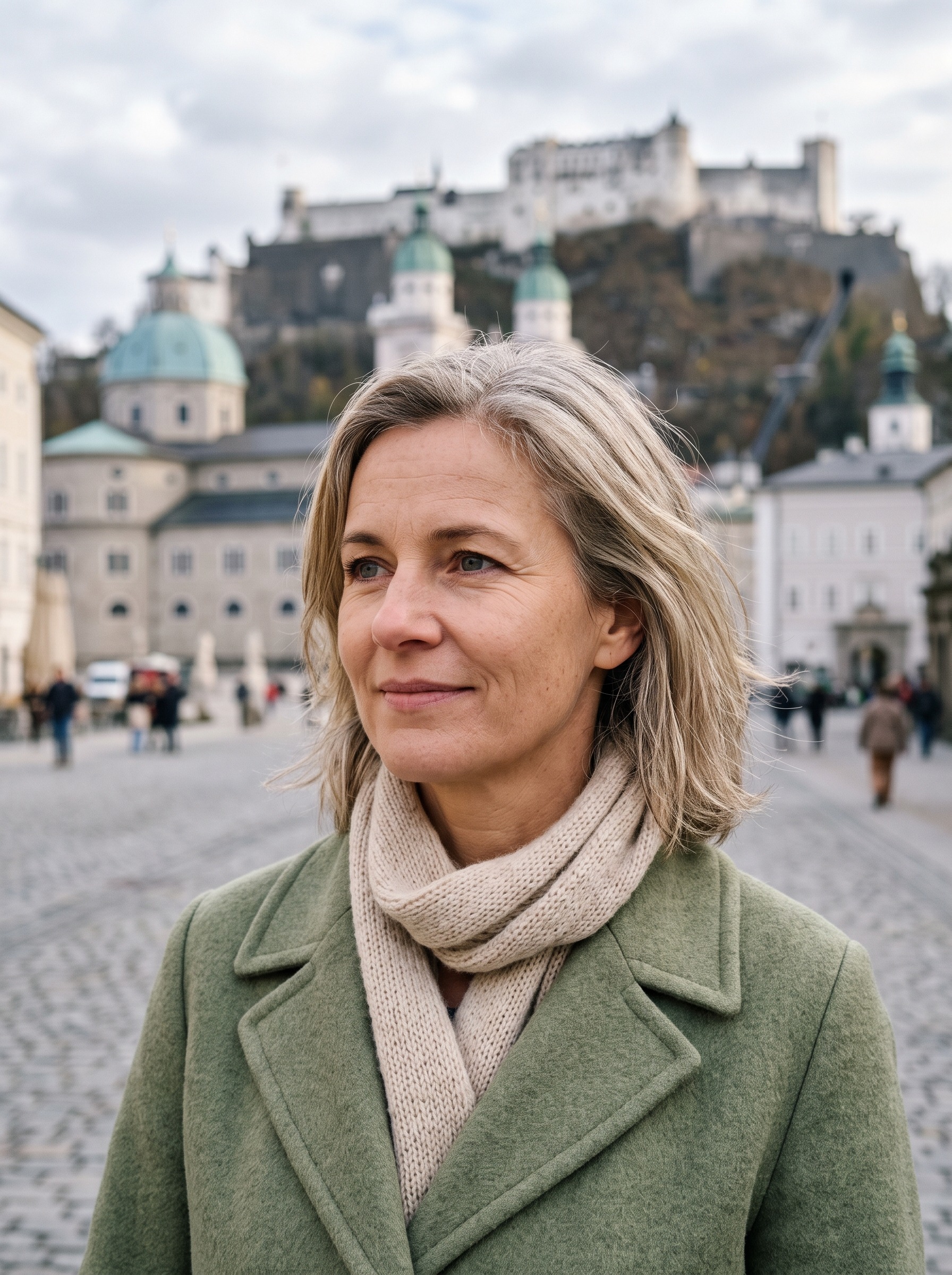

Walk through the Neutor and the city changes by degrees rather than by decree: the crowds of Getreidegasse thin, the pavement widens into a residential street, and within a hundred metres Salzburg seems to lower its voice. That is Riedenburg’s first gift. It does not announce itself with a square or a showpiece façade. It arrives as chestnut shade on Leopoldskronstraße, as the steady hush of the Almkanal under the pavements, as a district where people are clearly living their lives rather than performing Salzburg for visitors.
What Riedenburg is known for
Riedenburg is defined by edges. To the north, the wooded wall of the Mönchsberg; to the south, the reedy openness of the Leopoldskroner Moos; to the west, Maxglan; and between them, a neighbourhood of low-slung streets, villa gardens and small daily routines. It feels less like a destination than a pause in the city’s cadence. Grand Gründerzeit villas from the 1880s line streets such as Sinnhubstraße and Reichenhaller Straße, their facades broad and calm in the way only old residential Salzburg can be. Leopoldskronstraße runs beneath what locals claim is Austria’s oldest chestnut alley, and on a warm afternoon the road can feel almost ceremonial, though nobody here seems in a hurry to make a fuss of it.

Two landmarks give the district its shape. The first is the Neutor, formally the Sigmundstor, bored straight through the Mönchsberg between 1764 and 1767. It is Austria’s oldest road tunnel, and still the quickest way between this neighbourhood and the Old Town. Step through it and the switch is immediate: tourist Salzburg on one side, residential Salzburg on the other. The second is Schloss Leopoldskron and its millpond, the Leopoldskroner Weiher, on the southern edge. The palace itself is private now, open only to guests, but the 13-hectare pond remains public, and the view from its shore path is one of the city’s gentlest luxuries: palace, fortress and the Gaisberg all in one frame, with water doing the work of a mirror.
The district has a quieter historical layer too, one that is easy to miss if you arrive only looking for sights. The Rainberg, the wooded hill that gave Riedenburg its old name, was once a Neolithic settlement site and later a working quarry. Since around 1955 it has been a strict nature reserve, closed to the public. In a city so often read through monuments, that closed hill is almost a statement in itself: some parts of Salzburg are for looking at, not climbing.
Where to eat & drink
Riedenburg’s food scene is small, but it is the kind of small that grows on you. The concentration is around Neutorstraße, the district’s spine, where everyday life and good cooking meet without ceremony. At the top of the local list is Merkel & Merkel at Neutorstraße 31, set in the handsome villa generations of locals knew as Restaurant Riedenburg. Since February 2026 it has been run by the married chefs Ramona and Alexander Merkel, who reinterpret Austrian classics such as schnitzel and Tafelspitz with tight, ingredient-led precision. Gault&Millau awarded them two toques, but what matters on the ground is the chestnut-shaded garden in summer and the vaulted cellar Salettel when the weather turns. It is the sort of place where lunch can stretch into evening if the wine list is doing its job.

For the everyday rhythm of the neighbourhood, Bäckerei Holztrattner at Neutorstraße 32D does exactly what a local bakery should: warm bread, pastries and a daily-changing hot lunch that has become part of the district’s lunch hour. Its roots reach back to a Salzburg bakery founded in 1350, which is the sort of lineage that explains why people here still trust it for a loaf and a quick plate. A few doors away, Konditorei Rainberg at Neutorstraße 32C has been open since 1950 and carries 89 Falstaff points. It is the classic Kaffee-und-Kuchen stop, the place for apple strudel and Malakoff torte when the afternoon wants to slow down. These are not headline-grabbing addresses, and that is precisely why they matter: they are part of the neighbourhood’s working grammar.
For breakfast or brunch, Quartier Café on Moosstraße 1D offers an easygoing table in the modern Quartier Riedenburg development just past the Neutor. It is closed on Mondays, which feels entirely in keeping with a district that does not overpromise. You come here for the morning calm, not for a scene.

Things to do / what to see
Riedenburg is a district you walk rather than tick off. The most obvious place to begin is the Leopoldskroner Weiher, where the shore loop is flat, pram-friendly and quietly photogenic. Ducks, geese, swans and grebes move across the water, and on a still morning the fortress sits in the reflection as if it had been placed there for balance. There is a small playground by the path for families, and the rules are part of the atmosphere: swimming and winter skating are both banned to protect the wildlife, so the pond remains a place for strolling, not spectacle.

From here, the neighbourhood opens into its other quiet route: up onto the Mönchsberg the local way. A staircase just north of the Sigmundstor climbs from the residential streets into the woods, and in a few minutes you are on the ridge trail without having threaded through the Old Town crowds. The path passes viewpoints such as the König-Ludwig-Fernsicht, with the Berchtesgaden Alps filling the horizon on a clear day. Up top, the Museum der Moderne Mönchsberg sits in a sharp stone box on the plateau, showing contemporary art Tuesday to Sunday from 10:00 to 18:00 and on Wednesdays until 20:00. Its terrace restaurant, m32, designed by Matteo Thun, serves from noon to 10pm and has one of the best-framed views over the rooftops and fortress. It is the kind of place where the view is so composed that the city below seems almost like a model.
If you prefer to arrive by machine rather than muscle, the Mönchsberg Lift at Anton-Neumayr-Platz on the Old Town side takes you up 60 metres in about half a minute. A single ride is around €3.40, a return around €4.80, and one ride is free with the Salzburg Card. It is an efficient way to reach the museum entrance, though the quieter pleasure is still the staircase from Riedenburg, where the shift from street to woodland happens with almost no fanfare.

Water runs through the district in a more practical register. The Almkanal, one of central Europe’s oldest water-management systems, branches here into the Neutorarm and Müllner Arm on its way from the south into the Old Town. Its towpath is a shaded walking and cycling route that leads out toward the Leopoldskroner Moos meadows. Follow it far enough and you pass the Villa Berta pond by Sinnhubstraße, once the private lake of a mayor’s summer villa. This is Riedenburg at its most characteristic: not a grand gesture, but a chain of small, lived-in edges linked by water and shade.
{{ATTRACTIONS}}
Shopping & markets
Riedenburg is not a shopping district, and that is part of its appeal. Neutorstraße functions instead as a workaday high street, the sort of place where errands happen in the same few ground-floor rooms of old villas. Alongside the bakeries you find hairdressers, small offices, occasional design studios and Antiquitäten Rath at Neutorstraße 46, all folded into the residential fabric. The newer Quartier Riedenburg development on the Moosstraße side adds a few contemporary units and a supermarket for self-caterers, which is enough for the practical needs of anyone staying here for more than a night or two.
For more ambitious shopping, the district knows its place. Cross back through the Neutor and you are in the Old Town’s orbit again: the boutique-lined Getreidegasse with its wrought-iron guild signs, the department stores on the right bank, the produce and flower stalls of the Grünmarkt on Universitätsplatz. Riedenburg is better understood as the place to pick up a warm loaf, a box of pastries and perhaps a bottle of wine before an afternoon by the pond than as a destination for retail therapy. It is a neighbourhood of provision, not display.
Where to stay in Riedenburg
This is one of Salzburg’s most quietly useful bases. The best address range lies between the Neutor and the Leopoldskroner Weiher — Neutorstraße, Sinnhubstraße, Leopoldskronstraße — where you are inside a ten- to fifteen-minute walk of the Old Town but wake to birdsong and villa gardens rather than tour groups. Accommodation here tends toward guesthouses, design apartments and small villa-style stays rather than large hotels, which suits families and longer visits well. There is usually more space, sometimes a kitchen, often a garden, and parking is far easier than across the Mönchsberg.
Proximity matters street by street. A place near the pond puts the Festival Halls within a brisk stroll and Schloss Leopoldskron on your doorstep; a room by the Neutor gives you the shortest possible hop into the Baroque core. Prices generally sit below the Altstadt for comparable comfort, especially outside festival weeks in July and August, when the city fills and availability tightens early. Choose the pond side if you want the greenest, calmest setting. Choose the Neutor end if every saved minute to the sights matters more than the view from the window.
{{HOTELS}}
Getting around
Riedenburg is central in a way that can be easy to overlook because it feels so residential. On foot, the Neutor tunnel puts you at the western edge of the Old Town — Herbert-von-Karajan-Platz and the Festival Halls — in well under ten minutes. The cathedral and Getreidegasse are around 10 to 15 minutes away. City Obus and Albus lines run along Neutorstraße and Moosstraße, linking the district to Hanuschplatz on the river and onward to the Hauptbahnhof. Single tickets are cheapest bought in advance or via app, which is worth remembering if you are coming and going more than once a day.
The practical advantages continue. The main train station is roughly 10 minutes by bus, making this a sensible base for day trips to Hallstatt, Werfen or the Untersberg. Cyclists have the flat Almkanal and Salzach paths, which connect the district to the wider city without fuss. Drivers, meanwhile, benefit from street and villa parking that simply does not exist across the Mönchsberg. Salzburg Airport is about 10 to 15 minutes by taxi or a short bus ride west through Maxglan. In other words, Riedenburg gives you the rare Salzburg combination: close to everything, but not crowded by it.
The neighbourhood’s rhythm is what stays with you. A bakery window steaming at breakfast. A pram rolling along the pond path. The sound of bicycle bells and church bells crossing the same air. Riedenburg does not compete with the Old Town; it shelters beside it, and that is why returning travellers often end up here. After the city’s bright centre, this is where Salzburg lets its shoulders drop.
FAQs
Is Riedenburg a good area to stay in Salzburg?
Yes, if you want quiet, space and easy walking access rather than being right inside the tourist core. Riedenburg is a leafy residential district west of the Old Town, reached through the Neutor tunnel in under ten minutes, with easier parking and often better value than the Altstadt. It works especially well for families, drivers and repeat visitors.
Can you visit Schloss Leopoldskron and the lake in Riedenburg?
The palace itself is a private hotel and is open only to guests, but the Leopoldskroner Weiher beside it is public. You can walk the shore path for the classic view of the palace with the fortress behind it. Swimming and winter skating are not allowed because it is a protected wildlife habitat.
How do you get from Riedenburg to Salzburg's Old Town?
The quickest route is on foot through the Neutor, the 18th-century tunnel through the Mönchsberg, which reaches the western edge of the Old Town in well under ten minutes. Buses also run along Neutorstraße and Moosstraße, and the flat canal paths make cycling easy.
What is Riedenburg best for?
Riedenburg is best for calm residential stays, lakeside and canal walks, relaxed local dining and easy access to the centre without the crowds. It is a good fit if you prefer a neighbourhood feel, and less suitable if you want nightlife or to step straight from your hotel into the main sights.