Tel Aviv guide
Lev HaIr, Tel Aviv: the White City at street level
A walkable centre of Bauhaus facades, balcony breakfasts, late-night bars and the kind of Tel Aviv energy that never quite stays indoors.
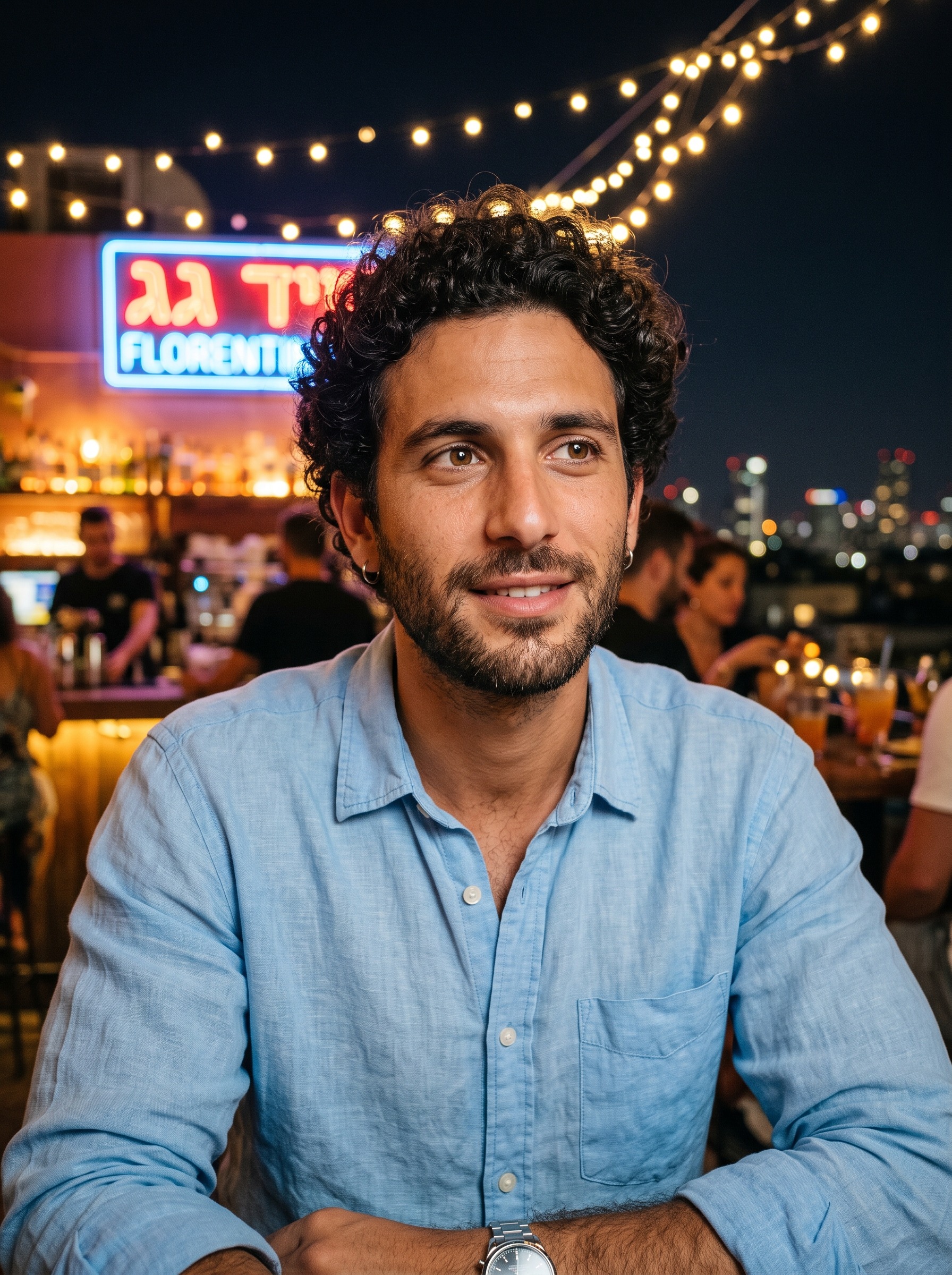

Lev HaIr means heart of the city, and here that isn’t a slogan so much as a map coordinate. Stand on Rothschild Boulevard in the morning and you can feel the neighbourhood waking in layers: a rented bike sliding along the shaded median, a coffee kiosk opening its shutters, office workers cutting through in shirtsleeves, old men already occupied with the benches, the dogs, the day. The streets are flat, the blocks are close, and the city’s planning history sits right on the surface. This is where Tel Aviv was laid out in 1909, and where the White City still shows itself in curved balconies, ribbon windows and stairwells tucked into cracked white plaster. Some facades have been lovingly restored; others are still waiting, wrapped in scaffolding or simply peeling in the sun. Lev HaIr is polished and scruffy at once, expensive and casual, architectural and deeply social. It is the part of Tel Aviv where you can spend the day reading buildings and the night reading the room.
What Lev HaIr is known for
The first thing people come for is the White City, and the second thing is that they usually stay longer than planned. This is the world’s largest concentration of Bauhaus and International Style architecture, roughly 4,000 buildings mostly from the 1930s, and UNESCO has had its say since 2003. The pleasure of Lev HaIr is that the architecture is not cordoned off like a museum object. It is the street itself. You see it from a café table, from the median of Rothschild Boulevard, from a taxi window if you are late, from the shadow of a jacaranda when the heat starts to press down.
Rothschild is the spine, a wide avenue that feels less like a road than a civic habit. The best-restored facades line its length, and the boulevard’s pedestrian-and-cycle median gives the whole district a long, slow pulse. Halfway up sits Independence Hall at Rothschild 16, the former home of Meir Dizengoff, where David Ben-Gurion read out the Declaration of Independence in May 1948. It is under major restoration, so the practical thing is to check access before you go; the exhibits have moved to a temporary visitor centre in the Shalom Meir Tower. Even in that suspended state, it carries the weight of the city’s origin story. Lev HaIr is full of places that ask you to look twice, and this is one of the few that asks you to look backwards as well.

At the northern end, Habima Square shifts the mood from residential elegance to civic theatre. Dani Karavan’s plaza, finished in 2010, has a sunken garden and a distinct sense of stagecraft; it fronts the Habima Theatre and the Charles Bronfman Auditorium, home of the Israel Philharmonic, with the Helena Rubinstein Pavilion for contemporary art close by. You do not need to be going to a performance to pause here. The square works as a hinge between the boulevard and the wider city, a place where the centre opens out and shows you it is also a cultural district, not just a handsome one.
Where to eat & drink
Food in Lev HaIr moves between polished and quick, and the distance between them is part of the pleasure. One morning you are on a balcony with a white tablecloth; the next you are eating standing up with tahini on your wrist. At the refined end, Hotel Montefiore on Montefiore Street has made a name for itself with a French-Vietnamese brasserie and lavish breakfasts on a plant-fringed balcony. It is the kind of place where the morning feels slightly dressed up, as if Tel Aviv had decided to be formal before remembering it is Tel Aviv.
Alena at The Norman, on Nachmani 23–25 just off Rothschild, is the other kind of destination meal: polished Mediterranean-European cooking, a weekend brunch people cross the country for, and a wine list that has repeatedly been voted Israel’s best. That matters here because Lev HaIr is not only about what is on the plate; it is also about the ritual of sitting still in the middle of a city that keeps moving around you. The Norman understands that perfectly.
Café Noir on Ahad Ha’am has been doing this since 1997, and it still feels like the old-school French bistro people book for a reason. The reason is the schnitzel, famous enough to have become part of the neighbourhood’s oral tradition. It is one of those places that reminds you Tel Aviv can still do classic without turning it into nostalgia.

Then there is the street-food Tel Aviv that often ends up defining the night. Miznon on King George is loud, cheap and beloved, the Eyal Shani joint where whole roasted baby cauliflower and stuffed pitas are the point. Port Said, tucked behind the Great Synagogue off Allenby, is his other essential address here: a lively, vinyl-soundtracked bar-restaurant that runs late and seems to gather momentum as the evening deepens. If you want the centre at its most local and least self-conscious, this is a good place to start. The room is full of people who know they are in the middle of something.
For a signature snack, Frishman Sabich at Frishman 44 by Dizengoff does exactly what Tel Avivians expect from the city’s beloved vegetarian pita: fried eggplant, egg, potato and tahini, all packed into something you can eat on the move. And when the night needs a final, greasy punctuation mark, Tony Vespa has you covered, with branches at the Habima end of Rothschild and on Allenby 118, selling crisp pizza by weight until very late.

Going out
Lev HaIr is one of Tel Aviv’s premier drinking quarters, but it does not do nightlife in one register. It can be theatrical, polished, basement-gritty or just plain crowded. Bellboy, hidden in Hotel B Berdichevsky at Berdichevsky 14, is the one that leans hardest into performance. Drinks arrive in conch shells, bathtubs and Viking horns, and the 1920s-surrealist decor makes the whole thing feel like a scene rather than a bar. Behind it, through a coded door, sits The Butler, a one-room speakeasy that strips the idea down to the cocktail itself.
Imperial Craft Cocktail Bar at HaYarkon 66, near the seafront edge of the centre, is the veteran in the room, the bar that helped put Tel Aviv on the cocktail map and still carries the confidence of a place that knows what it is doing. The 6–8pm happy hour is part of the ritual now; so is the sense that you are in a room with a reputation. Spicehaus takes a different route, turning the pharmacy gimmick into a whole aesthetic, with bartenders in white coats and drinks served in graduated beakers. It is playful without being silly, which is harder than it looks.

For something rougher around the edges, Radio EPGB on Nachalat Binyamin is a graffiti-slashed CBGB-style basement where live rock, indie and electronic sets keep the room from ever settling down. And when the night has more stamina than you do, Kuli Alma at Mikveh Israel 10, on the Allenby edge of the district, brings together DJs, exhibitions and a young, mixed crowd until dawn. This is where Lev HaIr stops being a place you pass through and becomes a place you stay in too long, which is usually how the best nights in Tel Aviv happen.
The streets branching off Rothschild and the Nachalat Binyamin mall fill with spill-out bar crowds most nights, and that spill matters. The centre’s social life is not contained by the venues; it leaks onto the pavements, into the crossings, onto the benches, into the small gaps between one plan and the next. That is the rhythm here. One bar leads to another, and another, until you are either heading home or deciding not to.
Things to do / what to see
Start with the architecture, because in Lev HaIr the buildings are the plot. Walk the length of Rothschild Boulevard and read the restored Bauhaus facades as you go, then join a White City walking tour if you want the details to stop being decorative and start being legible. The Bauhaus Center at Dizengoff 77 is the usual starting point for that kind of reading. It runs guided English tours, typically Friday and Sunday mornings, and the shop sells maps and design pieces that make sense of the district long after you have left it.

Habima Square deserves a proper pause, not just a glance from the bus. The sunken garden, the theatre, the auditorium and the pavilion create a small cultural campus in the centre of the city, and the square’s geometry gives the area a slightly ceremonial feel that Tel Aviv does not always bother with. Nearby, the Helena Rubinstein Pavilion adds contemporary art to the mix, while the Habima Theatre and Charles Bronfman Auditorium anchor the place in performance rather than display. It is one of those corners of the city where the public realm still feels like a civic idea.
Independence Hall at Rothschild 16 is the historic core of the whole neighbourhood’s story, though at the moment the practical note is more important than the symbolic one: it is under restoration, so confirm access and check the temporary Shalom Meir Tower exhibit first. The building matters not because it is a relic but because it sits inside the very fabric that the city keeps walking past. That is Lev HaIr in miniature: history folded into daily movement.
The easiest thing to do, though, is also the most Tel Aviv thing to do. Rent a bike from a docking station, coast the median, stop for coffee at one of the boulevard kiosks, and let the flatness of the district do what it does best. When the streets get too warm, the beach is a ten-minute walk west. That proximity is not an afterthought. It is the neighbourhood’s operating system.
{{ATTRACTIONS}}
Shopping & markets
The shopping here is less about one grand retail street than about a sequence of useful, characterful corridors. The signature event is the Nahalat Binyamin Arts & Crafts Fair, which runs every Tuesday and Friday, roughly 10:00–17:00 and later in high summer. More than 200 artists set up there, and everything is original and handmade, sold by the makers themselves. Ceramics, jewellery, prints, gifts — all of it threaded through a pedestrian mall with buskers and café terraces, between Allenby and the Carmel Market. It is one of the few places in the city where the market energy feels artistic rather than merely commercial.
The fair bleeds straight into Shuk HaCarmel on the western edge, and that transition is part of the fun. The Carmel Market is the city’s biggest and busiest bazaar, full of produce, spices, cheap eats and household clutter, and it can feel gloriously unruly after the more curated calm of the craft fair. Sheinkin Street, running east off the boulevard, is the boho shopping strip, with independent fashion, vintage and design boutiques between the cafés. King George and Allenby are grittier by comparison, but they are also where the everyday city keeps its practical backbone.
For design objects and Bauhaus-themed prints and books, the shop at the Bauhaus Center is the reliable stop. It is less a detour than a continuation of the neighbourhood’s main obsession: making the city itself into something you can read, carry home, and keep looking at.
Where to stay in Lev HaIr
Lev HaIr is the classic first-visit base because it solves the city’s geography for you. You can walk to the beach, the market, the museums and the nightlife without thinking too hard about transport, and in Tel Aviv that is worth a lot. The best hotel pockets cluster around Rothschild Boulevard and Montefiore Street, where design-led stays like Hotel Montefiore, The Norman on Nachmani and Hotel Rothschild 22 create a calmer, leafier feel while keeping you close to the cafes and the sights. That is the version of Lev HaIr that works best if you like stepping out into the city rather than being dropped into it.
{{HOTELS}}
The trade-off is simple and worth saying plainly. The streets around Nachalat Binyamin and Allenby put you right in the thick of the bars and the market, which means atmosphere but also noise late into the night. Pick that zone if you plan to be out yourself. Toward HaYarkon Street on the western edge, you trade a little of the Bauhaus character for a shorter walk to the sand. Prices skew high across the board, because central Tel Aviv is expensive and knows it. The best-value rooms are usually a couple of streets back from the boulevard rather than on it.
Getting around
Lev HaIr is small, flat and made for walking. Most of it sits within a 15-minute stroll of Rothschild Boulevard, and the beach is about ten minutes west on foot. That shape is the neighbourhood’s quiet luxury: you do not need to plan too much because the city has already done the geography for you.
Cycling is the local shortcut, and docking stations for the city bike-share sit along the boulevard. The protected median makes it easy, even if you are only drifting a few blocks. Since August 2023, the Red Line light rail has served the centre, with Allenby and Yehudit stations both within a short walk of Rothschild; one Yehudit exit comes up onto the boulevard itself. The line links south to Jaffa and Bat Yam and northeast toward Petah Tikva. Frequent buses run along Allenby, King George, Ibn Gabirol and Rothschild. Tap a contactless card or use the Rav-Kav or local transit app to pay.
Public transport largely pauses for Shabbat, from Friday afternoon to Saturday evening, when sherut shared taxis and regular taxis fill the gap. Ben Gurion Airport is about 20–30 minutes away by taxi or a short train ride from Tel Aviv’s mainline stations on the city’s eastern side. In other words: Lev HaIr is easy, but it rewards the kind of traveller who likes to move on foot and notice what the city does between one corner and the next.
FAQs
Is Lev HaIr a good area to stay in Tel Aviv?
Yes — for a first visit it is the obvious base. You are within a flat ten-to-fifteen-minute walk of the beach, Carmel Market, Rothschild Boulevard, the museums and much of the nightlife. The trade-offs are price and noise, especially around Nachalat Binyamin and Allenby.
Is Lev HaIr safe at night?
Generally yes. It is busy, well-lit and comfortable to walk through day and night, especially around Rothschild. Use normal city common sense in crowded market areas and on the bar streets late at night.
What should I not miss in Lev HaIr?
Walk Rothschild Boulevard for the Bauhaus facades, join a White City tour from the Bauhaus Center, pause at Habima Square, and check Independence Hall if it has reopened. For food and drink, Montefiore, Alena, Miznon, Port Said, Bellboy and Imperial are the names to know.
How do I get around Lev HaIr?
Mostly on foot. The area is flat and compact, bike-share stations line Rothschild, and the Red Line light rail serves Allenby and Yehudit. Buses run on Allenby, King George, Ibn Gabirol and Rothschild, and transport pauses for Shabbat.