Valletta guide
St. Barbara Bastion, Valletta: the city’s quietest view from the sea walls
A residential ledge above the Grand Harbour where Valletta goes hushed, the light gets better, and the best panorama in the capital comes with stone, balconies and almost no noise.
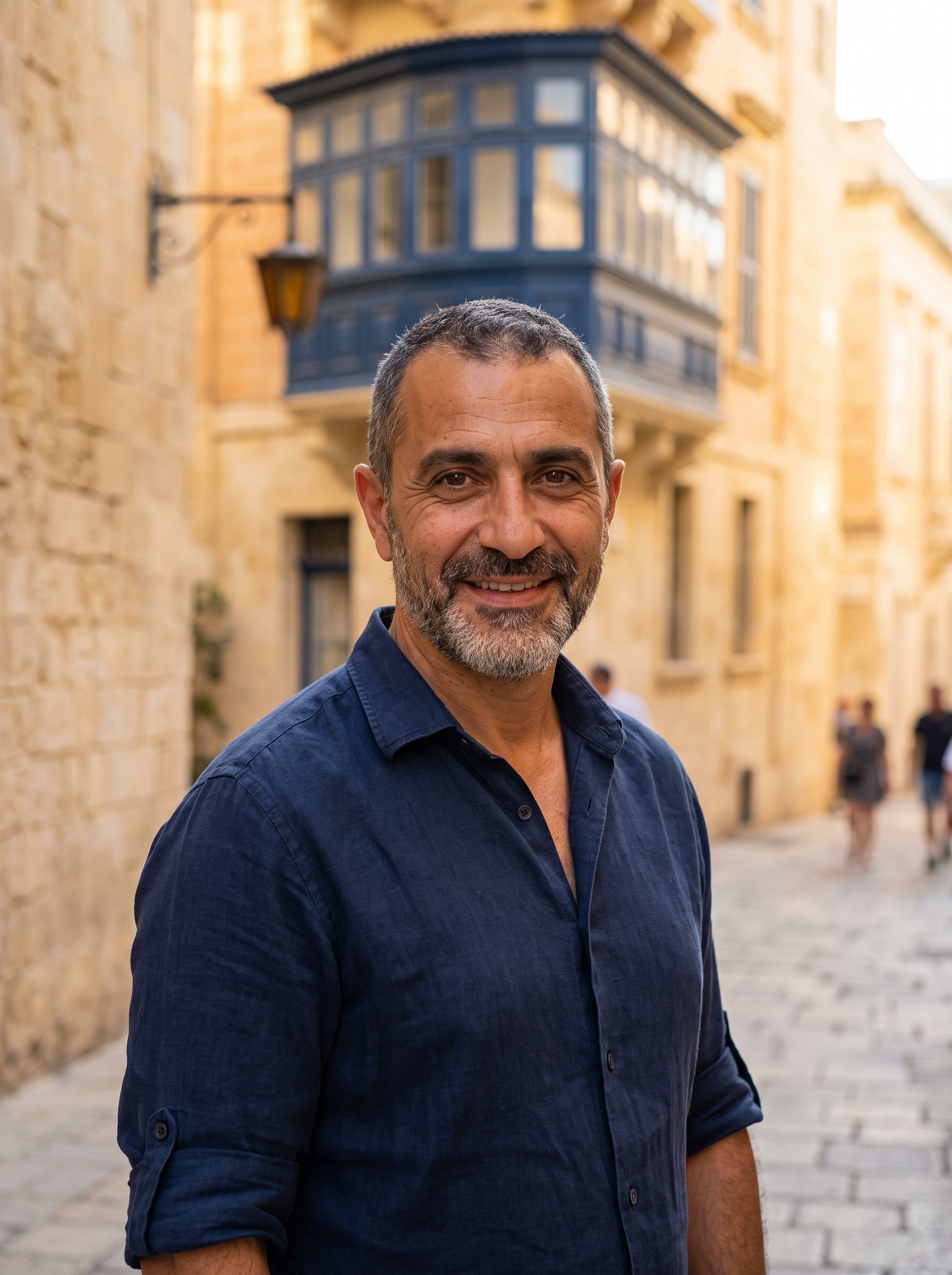

Follow the fortifications past the Lower Barrakka Gardens, take the left fork, and Valletta begins to behave itself. The traffic falls away, the voices thin out, and St. Barbara Bastion appears as a long, quiet ledge of stone running along the 16th-century sea walls. It is not a place that tries to impress you. It just stands there in the morning sun, with honey-coloured houses and enclosed timber gallariji looking straight over the Grand Harbour to Fort St Angelo and the Three Cities, as if that were the most natural thing in the world.
What St. Barbara Bastion is known for
This is Valletta at its most self-possessed. The bastion is essentially one residential lane balanced on the fortifications, with no through-traffic, no café terraces spilling across the pavement, and very little happening after dark beyond a wine glass on a balcony and the harbour lights coming on below. The wall faces roughly southeast toward Birgu and Fort St Angelo, so it catches the morning sun cleanly and stays a few degrees calmer than the Upper Barrakka crush a few streets uphill. That matters more than it sounds. Valletta can be noisy in the usual ways — tour groups, engines, the little urban friction of a compact capital — but here the city seems to lower its voice.
The bastion’s history is all military geometry and later domestic ambition. It was built in the 16th century as part of the fortifications the Knights of St John threw up after the Great Siege of 1565, though this stretch was never considered a front-line position. Fort St Angelo across the water covered it, so instead of a garrison of Knights it was handed to the Association of Bombardiers, the artillerymen who took St Barbara as their patron saint. Over time the top of the wall filled in with civilian houses, and what you see today is a row of 19th-century townhouses, restored and disciplined, with the kind of façade that makes a photographer pretend they are “just passing.”
The whole run is protected on the National Inventory of Cultural Property, and the Valletta Rehabilitation Project restored thousands of metres of the bastion façade between 2008 and 2009, which is why the stonework reads so cleanly now. There is an elegance to the repair. Nothing here looks scrubbed white or newly minted; it looks kept. That is the difference.
The address has become one of the most sought-after in the capital, and it behaves like one. The Honorary Consulate of Indonesia sits along the bastion, and the general mood is prestige without theatre: a place for residents, photographers who know what time the light arrives, and the occasional guest who has booked a townhouse stay with the harbour as the entire point.

What draws visitors is simpler than the history. Stand at the parapet and you get the same sweep across the Grand Harbour as the Upper Barrakka, but framed by houses and shared with a fraction of the crowd. Cruise ships thread the harbour mouth below. The Three Cities sit opposite like a stage set that has decided to remain in business for several centuries. If you come for one thing, come for that. Valletta has plenty of viewpoints; this is the one that feels lived in.
Where to eat & drink
The bastion itself is residential, so the good eating lives a few streets inland, and it is worth the short uphill walk. Valletta does this well: it makes you earn your supper by climbing a little, then rewards you with something honest.
Ta’ Nenu, at 143 St Dominic Street, is the first stop if you want to understand what Maltese ftira actually tastes like when it is done properly. For years known as Nenu the Artisan Baker, it bakes its ftira in a restored century-old stone oven, and the result is the sort of thing that makes you suspicious of every limp imitation you’ve eaten elsewhere. Crisp bottom, proper chew, loaded with potato, tomato, olives and tuna. No fuss, no performance. The kitchen also does rabbit stew and bragioli, and both belong to the category of dishes that taste like they have been around the island longer than the menu.

For a slower evening, Legligin on St Lucia’s Street is the place to settle into the city rather than merely dine in it. It is a cellar wine bar of brick vaults and wooden tables that has been going for the best part of two decades and holds a Michelin Plate, which is a neat way of saying the kitchen knows what it is doing without needing to shout about it. There is no à la carte. You get a roughly €45 run of Maltese small plates, with aljotta and linguine with local rabbit among the things to look out for, and a wine list that leans hard on Maltese producers. It is the kind of room where the light is low, the brick is old, and the conversation naturally slows down to match the plates.

Then there is ION Harbour by Simon Rogan, on the rooftop of Iniala Harbour House at number 11. It is Malta’s only two-Michelin-star restaurant, retained in the 2026 guide, and executive chef Oli Marlow runs Rogan’s farm-to-fork template as a 13-course tasting menu with the fortified harbour laid out below the dining room. This is the splurge, plainly. The sort of meal where the harbour view is not an accessory but part of the architecture. If you are going to spend serious money anywhere on this ledge, this is the table that justifies the climb.

Going out
There are no bars on the bastion, and that is the point. The local idea of a night out here is a glass of wine on a balcony while the harbour lights come on. It is not a district for stumbling between doors. It is a district for staying put.
The nearest evening spot is Bridge Bar at 258 St Ursula Street, a short walk and a set of steps away, sitting on the little bridge just behind Victoria Gate at the foot of the climb up to the bastion. It is one of the most relaxed drinking spots in the city, and from roughly May into autumn it runs its long-standing Friday jazz sessions. The crowd spreads out on cushions down the stone steps to listen, which is a very Maltese solution to the problem of limited space: sit on the stairs and call it atmosphere. Arrive early and pre-book a table if you want one.

Beyond that, Legligin doubles as a place to linger over wine, and the wider Strait Street bar strip is ten minutes uphill through the grid. If you want late, loud, or anything remotely resembling a stag-and-hen circuit, you cross the water. Sliema, St Julian’s and Paceville are where Malta actually goes out. St Barbara Bastion is for the after-hours version of a decent evening: the last sip, the harbour in the dark, and the knowledge that you can still hear yourself think.
Things to do / what to see
The main event is simply walking the wall. That sounds almost too plain for a place with this much history and this much view, but plain is the right word. St Barbara Bastion does not need a ticket booth or a grand reveal. You arrive, you lean on the parapet, and the Grand Harbour opens in front of you.
From the top you get the postcard sweep across the harbour to Fort St Angelo, Birgu and Kalkara — the same view that ends up on half of Malta’s postcards, minus the coach parties. Photographers should time it for first light or golden hour, when the southeast-facing wall glows and the harbour is at its calmest. It is a reliably good spot for both landscape shots and the architecture of the gallariji-fronted houses, because the buildings are part of the frame, not a distraction from it. There is a reason people keep coming back with cameras. The light does half the work.
{{ATTRACTIONS}}
Follow the fortifications a few minutes north and you reach the Lower Barrakka Gardens, a quiet formal garden on St Christopher’s Bastion with a neoclassical temple monument to Admiral Alexander Ball and, alongside it, the Siege Bell War Memorial. The bell tolls at noon for the dead of the WWII siege, and the whole setting feels far calmer than the busier Upper Barrakka uphill. That calm is part of the appeal of this corner of Valletta: even the memorials seem to breathe.
Time your visit for early July and the bastion becomes a free grandstand above the Malta Jazz Festival, staged in the open air at Ta’ Liesse on the waterfront directly below, with Fort St Angelo lit up across the water behind the band. It is a rare city scene that manages to feel both ceremonial and easygoing. The music rises from below, the wall holds steady above it, and the harbour does what it has always done.
Where to stay in St. Barbara Bastion
This is one of Valletta’s most desirable and most limited places to sleep: a handful of restored townhouses and self-catering conversions rather than a hotel district, so book well ahead. The appeal is obvious and slightly selfish in the best sense. You are not here because it is convenient to everything. You are here because the view is the thing.
Iniala Harbour House at 11 St Barbara Bastion is the anchor. It is a five-star boutique hotel spread across four restored 17th-century townhouses, with around two dozen rooms and residences, private butlers for suite guests, a spa set into the old stone vaults and rooms starting well into the hundreds of euros a night. It is where you stay if the harbour view and the ION Harbour table are the whole reason for the trip. The building understands the address better than most. It does not compete with the bastion; it sits inside it.
Around it, the appeal is the same for smaller budgets: view-rich, quiet, converted-townhouse stays where a top-floor room can open onto that harbour panorama. Expect the trade-offs of any Valletta address — stairs rather than lifts, no parking to speak of, and a residential lane that stays silent at night. Rooms facing the water are worth paying up for; that view is the entire point of staying here rather than in the busier centre.
{{HOTELS}}
Shopping
There is not much in the way of shopping on St. Barbara Bastion itself, and that is not a flaw so much as a definition. This is a residential lane on the sea walls, not a retail street, and the absence of shopfront clutter is part of why it feels so clear-eyed. If you want souvenirs, fashion or the usual city-centre browse, you head back toward the busier streets inland. Here, the value is in the stone, the balconies and the light. Valletta can keep its gift shops; this corner keeps its view.
Getting around
St Barbara Bastion sits at the harbour edge of Valletta, reached on foot. From the tip of the peninsula, follow the fortifications past the Lower Barrakka Gardens and take the left fork. From the lower town, the approach is up the steps behind Victoria Gate, which sits at the foot of the climb. Fine on two working legs, but genuinely steep and uneven, so not the address for anyone with mobility issues.
The whole quarter is pedestrianised; there is effectively no parking. It is about a 10–15 minute walk from the main City Gate and the Valletta bus terminus, the hub for buses to Mdina, the Three Cities, the beaches and the airport, roughly 30–40 minutes out by bus or taxi. For the Three Cities, the small passenger ferry docks at Lascaris Wharf just below Victoria Gate, a few minutes’ walk downhill, and the Sliema ferry — your quick route to the nightlife — leaves from the other side of the peninsula near the Marsamxett waterfront.
The practical truth is simple: if you stay here, you live by the stairs. Wear proper shoes, especially after dark. The reward is that the city opens and closes around you at walking pace, which is probably the best way to understand Valletta anyway.
FAQs
Is St. Barbara Bastion a good area to stay in Valletta?
Yes, if you want quiet and a view over a nightlife strip. It is a residential lane on the sea walls with the best Grand Harbour panorama in the city and a handful of restored-townhouse stays, headlined by the five-star Iniala Harbour House. The trade-offs are steep steps, no parking, and very little on the doorstep after dark — but central Valletta and its bars are a short walk uphill.
Where is the best harbour view in Valletta?
Locals point to St Barbara Bastion. The wall gives you the same sweep across the Grand Harbour to Fort St Angelo and the Three Cities as the famous Upper Barrakka Gardens, but framed by 19th-century townhouses and shared with far fewer people. Come at sunrise or golden hour, when the southeast-facing wall catches the light.
Is there anywhere to eat and drink on St. Barbara Bastion?
Not on the bastion itself — it is residential — but everything is a few minutes’ walk. Ta’ Nenu does traditional oven-baked ftira and rabbit on St Dominic Street, Legligin runs a Maltese small-plates wine cellar on St Lucia’s Street, the Bridge Bar hosts seasonal Friday jazz down by Victoria Gate, and ION Harbour by Simon Rogan — Malta’s only two-Michelin-star restaurant — is on the roof of Iniala Harbour House on the bastion itself.
Is St. Barbara Bastion easy to reach on foot?
Yes, but only if you are comfortable with steep, uneven steps. It is about a 10–15 minute walk from City Gate and the Valletta bus terminus, with the approach either via the fortifications past Lower Barrakka Gardens or up the steps behind Victoria Gate.